


MCAT Equations What to Memorize and How to Use Them




The MCAT doesn't give you a formula sheet, so your prep needs to build one into your brain. Memorizing high-yield equations is only half the job; knowing which formula fits a scenario and how to rearrange it under pressure is what actually moves your score.
If you're studying for the MCAT, you’ve probably heard this piece of advice more times than you can count: “You don’t need to memorize everything, just focus on understanding the concepts.” And while that’s mostly true, I’ll be honest, when it comes to equations, that advice gets a little fuzzy.
During my own MCAT prep, I quickly realized that understanding concepts and having key formulas ready to go was crucial for both speed and accuracy. So in this blog, I’m walking you through what I wish someone had told me earlier: what equations you actually need to memorize, how to think through them, and how to use them efficiently on test day.
Why Do You Need to Memorize Formulas for the MCAT?
The MCAT isn’t just a test of what you know; it’s a test of how fast and confidently you can apply what you know. And equations are a huge part of that.
Yes, some passages will walk you through theory and background. But more often than not, you’re expected to recall and apply equations from memory, with no cheat sheet to help. And when you’re under pressure, flipping through your mental “formula file” needs to happen fast.
So yes, memorizing matters, but so does knowing what to do once you recognize the equation. It’s not just plug-and-chug. It’s critical thinking with a mathematical twist.
How Often Are Equations Tested Across MCAT Sections?
Here’s how often I saw formulas come into play across sections:
- Chem/Phys: This is equation central. From circuits and kinematics to pH and equilibrium, formulas are everywhere.
- Bio/Biochem: Think enzyme kinetics, Michaelis-Menten, and thermodynamics.
- Psych/Soc: Less frequent, but you’ll still see some basic stats and maybe even standard deviations pop up.
- CARS: Believe it or not, I’ve even seen questions hint at statistical reasoning here. It’s rare, but being familiar with core relationships across subjects is helpful.
Can Understanding Equations Improve Your Overall MCAT Performance?
Absolutely. In fact, it’s one of the things that helped me feel less overwhelmed during the Chem/Phys section.
Knowing which formula to reach for can:
- Save time
- Cut down on silly mistakes
- Help you reason through a question when the answer isn’t obvious
Sometimes the question isn’t testing the math; it’s testing whether you understand the relationship between variables. And if you do, you’ll pick the right answer without ever picking up your calculator.
Understanding Equation-Based Questions
MCAT questions often go beyond just “use the formula.” You’ll need to:
- Use proportional reasoning (like: if velocity doubles, what happens to kinetic energy?)
- Rearrange equations algebraically
- Know what each variable actually means in a passage
I used to think I could just plug in numbers and move on. But on the MCAT, the real magic happens when you understand why the equation works and what it tells you about the scenario.
Mastering the Concepts Behind the Formulas
I’ll never forget when I first learned F=ma in school; it seemed so simple. But for the MCAT? You need to know more than just the formula:
- What does force actually mean?
- Why does acceleration matter more than speed?
- How does this show up in a system with friction or on an incline?
This is where Sketchy MCAT really helped me. Their visual mnemonics made it easier to connect formulas with real-life (or at least test-style) applications. Especially in biochem, I still remember their Henderson-Hasselbalch scenes!
Which MCAT Equations Should You Memorize?
Not all formulas are created equal. Some show up all the time, others only once in a blue moon.
Here’s how I figured out which ones were must-know:
- I tracked which equations kept showing up in AAMC and UWorld practice
- I highlighted formulas in Sketchy that came up repeatedly
- I kept a running “formula sheet” organized by subject and updated it as I reviewed
You’ll want to focus on:
- Kinematics
- Work/Energy/Power
- Gas laws
- Acid/base and equilibrium constants
- Michaelis-Menten & Lineweaver-Burk
- Circuit rules (V = IR, P = IV)
And remember: every equation is rearrangeable. Don’t just memorize one form—know how to solve for any variable in the equation.
When and How to Write Down Formulas on Test Day
Yes, you’re totally allowed to write formulas down, but only on your scratch paper.
Here’s a tip that made a huge difference for me: do a "brain dump" at the start of each section. I’d take 1-2 minutes to jot down:
- High-yield equations
- Key constants (like R=8.314, 1 atm=760 mmHg)
- Any conversions I often mixed up
That tiny ritual helped calm my nerves and saved me from second-guessing halfway through the section.
High-Yield Equations by Subject
Physics:
Some of the MVPs:
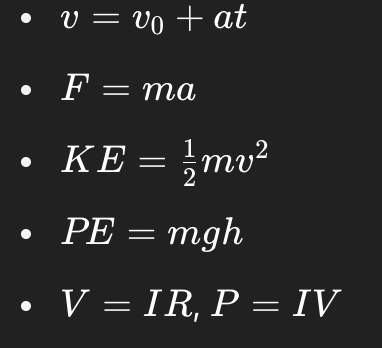
Sketchy ties these into visual stories, like cars accelerating or circuits lighting up a brain, which helps with long-term recall.
General Chemistry & Biochemistry:
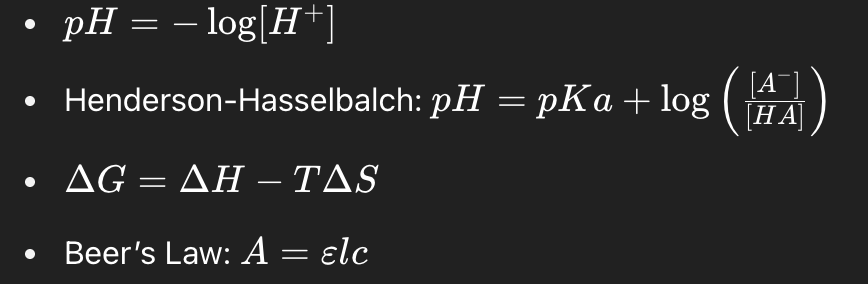
From titrations to energy diagrams, these show up across multiple topics. Sketchy’s "Enzyme Town" made things like Michaelis-Menten stick for me.
How to Practice Applying Equations
Reading flashcards isn’t enough. What helped me actually learn how to apply equations was:
- Doing Sketchy and AAMC practice, and taking time to review why a formula was used
- Practicing dimensional analysis to double-check my units
- Teaching myself how to explain what each part of the formula meant before solving
When I got stuck, I used this mini-strategy:
- Check the units in the question
- Look for keywords that signal a topic (velocity = kinematics, energy = thermodynamics, etc.)
- Use process of elimination to guess the right formula, then back it up with logic
Conclusion: Equations Are Your Secret Weapon
Here’s what I want you to remember: MCAT equations aren’t just math; they’re shortcuts to understanding.
When you:
- Memorize the key ones
- Understand how and when to use them
- Practice until it feels like second nature…
…you’ll fly through questions that might trip others up. Seriously.
Whether you’re watching Sketchy videos, building your own equation deck, or grinding through AAMC questions, start thinking of equations as your MCAT cheat codes. Know them well enough to see the test through a new lens.
You’ve got this!
