


How to Study for MCAT Physics (Without the Fear)


MCAT Physics tests concepts like electricity, magnetism, and energy that feel abstract at first but become manageable with the right visual memory approach. Sketchy MCAT turns the most intimidating physics topics into memorable scenes that actually stick on test day.
MCAT Physics has a reputation. The formulas, the invisible forces, the electricity and magnetism concepts that seem to defy intuition. If physics has ever made you want to close your textbook and walk away, you are not alone. But here is what most students do not realize: MCAT Physics is not about calculating answers from scratch. It is about understanding how physical principles apply to biological systems, and that makes it far more learnable than it looks.
Why Is Physics on the MCAT?
It might seem surprising that an entire section of the admissions test for medical school is about physics. Why not leave Newton to his apple tree and just expand the biology section for a more in-depth look at key topics like anatomy and physiology? Well…it turns out that physiology is just a slightly longer word for, uh, physics. Cells separate charges across their membranes kinda like batteries, neurons use electrical currents, and blood follows the laws of fluid dynamics. Of course there are also lung pressures and gas equations to understand respiration. Oh and an MRI involves magnets and x-rays use radiation. So yeah, turns out physics is kinda important to the entire human body / medicine situation. Even more so if you’re Frankenstein.
What MCAT Physics Topics Do You Actually Need to Know?
The Chemical and Physical Foundations section covers a focused set of physics topics. The highest-yield areas include:
- Electricity and magnetism: circuits, electric fields, magnetic forces on moving charges
- Work and energy: kinetic and potential energy, conservation of energy, non-conservative forces
- Light and optics: reflection, refraction, lenses, and the eye
- Waves and sound: frequency, wavelength, Doppler effect
- Fluids: pressure, buoyancy, flow rate
The scope is narrower than a full college physics course. Focus on understanding mechanisms and applying them to passage-based questions rather than memorizing every formula.
How Does Sketchy Make MCAT Physics Stick?
The challenge with physics is that the concepts are invisible. You cannot see an electric field or watch potential energy convert to kinetic energy in real time. That invisibility is exactly why visual mnemonics work so well for MCAT Physics. Sketchy MCAT takes abstract physics concepts and places them inside rich, story-driven scenes where every symbol corresponds to a specific principle or formula.
Take electricity and magnetism. Instead of memorizing that a charge moving perpendicular to a magnetic field experiences a force causing circular motion, you watch a scene where that exact interaction plays out visually. The image stays with you in a way that a formula on a flashcard never does. When the MCAT question describes a charged particle entering a magnetic field, the scene comes back instantly.
Electricity and Magnetism—Frightening Forces on the MCAT
So this Halloween save your teeth, unplug your doorbell, and check out our unit on Electricity and Magnetism. It’s got black cats, bats, witches and wizards, forests, full moons, and monsters—quite the spooky cast to guide you through topics like Coulomb’s law, conductivity and resistance, and capacitance. You definitely don’t want to miss these key details for the spookiest day of the year—MCAT test day.
A Monster of a Test
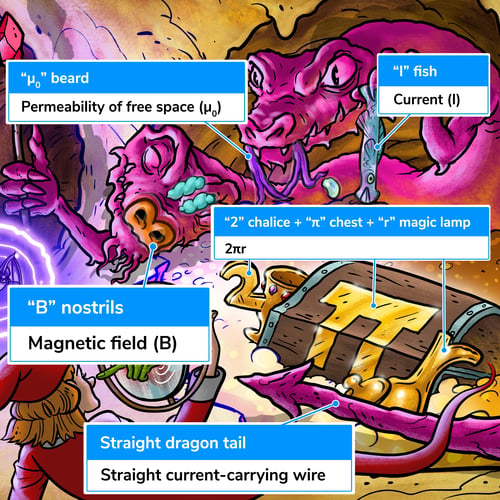
But let’s forget about that uh terrifying thought for a minute. Go ahead and wash off that vampire face paint and hang up that daring silk cape, because with Sketchy you can feel confident facing all kinds of harrowing challenges on the MCAT physics section—like Magnetic Fields or staring down this two-headed dragon.
Though it might not look like it, this fellow means well. He just wants you to remember how to calculate the magnetic field from a straight current-carrying wire. Really, that’s all. Promise. For more on the relationship between current and magnetic fields, head on over to this dragon’s lair (just don’t touch that treasure).
It Was a Dark and Stormy Night…
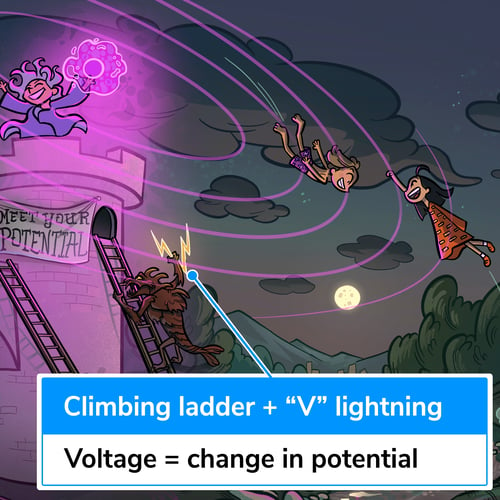
Of course, on Halloween there’s always the potential for some really scary stuff—like that one house in the neighborhood that hands out toothpaste instead of candy. Or like in this sketch about electrostatic potential energy. This voltage creature looks like it’s up to no good. You can tell because it makes more than one appearance around Sketchy—often getting into trouble. We use recurring symbols like this to help you store away super important information as you move from lesson to lesson and across units as you’re studying for the MCAT.
Superpowers Unite!
Fortunately the good forces around here seem to be pretty strong–definitely strong enough to help you recall how charges move through magnetic fields.
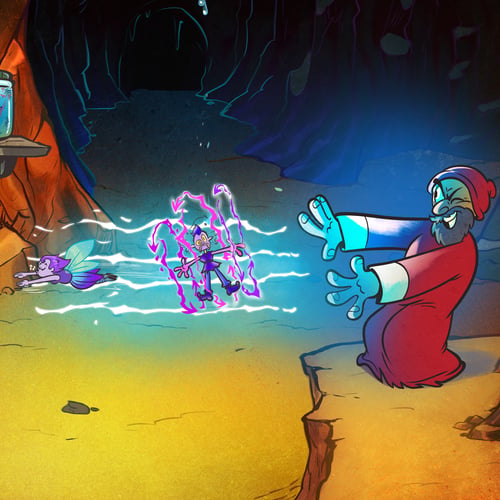
Can you guess which of these fairies is moving perpendicular and which is moving parallel? Hint: A charge moving perpendicular to a magnetic field experiences a magnetic force that causes it to move in a circular path.
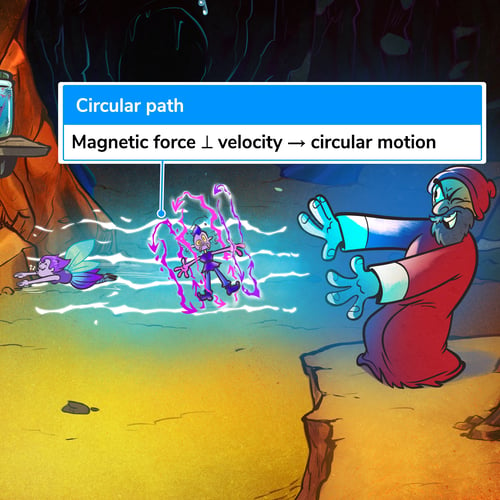
Check out our full MCAT physics lesson on Magnetic Forces to conjure some more magnetic magic.
All Work and No…Energy
As you can see, we weren’t joking about that spooky cast. But if all the monsters and supernatural forces aren’t frightening enough for you, take a ride into the depths of Sketchy’s mines. Bring a flashlight though because it gets dark; you definitely don’t want to be surprised by the Worcs.
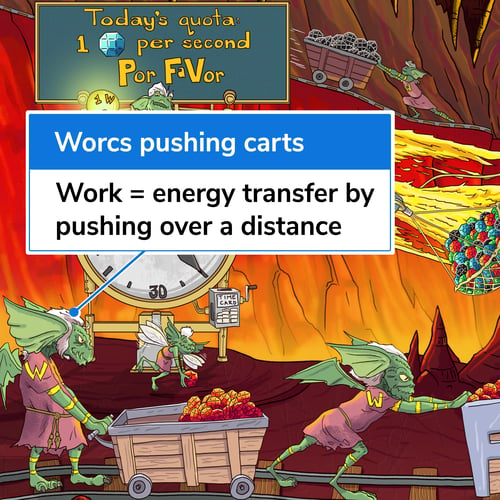
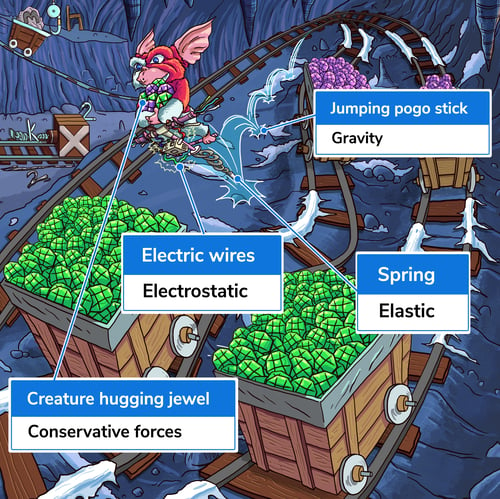
They don’t take their…uh work, lightly. But spend some time with them and you’ll know potential and kinetic energy forward and backward. Get it—forward and backward—conservation of energy…oof. Really though, forget that terrifying pun and check out Sketchy’s Work and Energy unit to learn about Kinetic and Potential Energy and Conservative and Nonconservative forces. Just look at this friendly(?) creature symbolizing which forces are conservative.
How Should You Study MCAT Physics?
Start with content review before you touch practice questions. Build a solid understanding of the core concepts in each unit, then move to applying them. Use Sketchy MCAT to build your conceptual foundation, then reinforce with practice questions from AAMC materials. Review every question you get wrong by going back to the underlying principle, not just the formula you missed. That kind of targeted review compounds fast.
Ready to take the fear out of MCAT Physics? Start a free trial at sketchy.com.
