


Sketchy vs. QBanks: What to Buy First Year


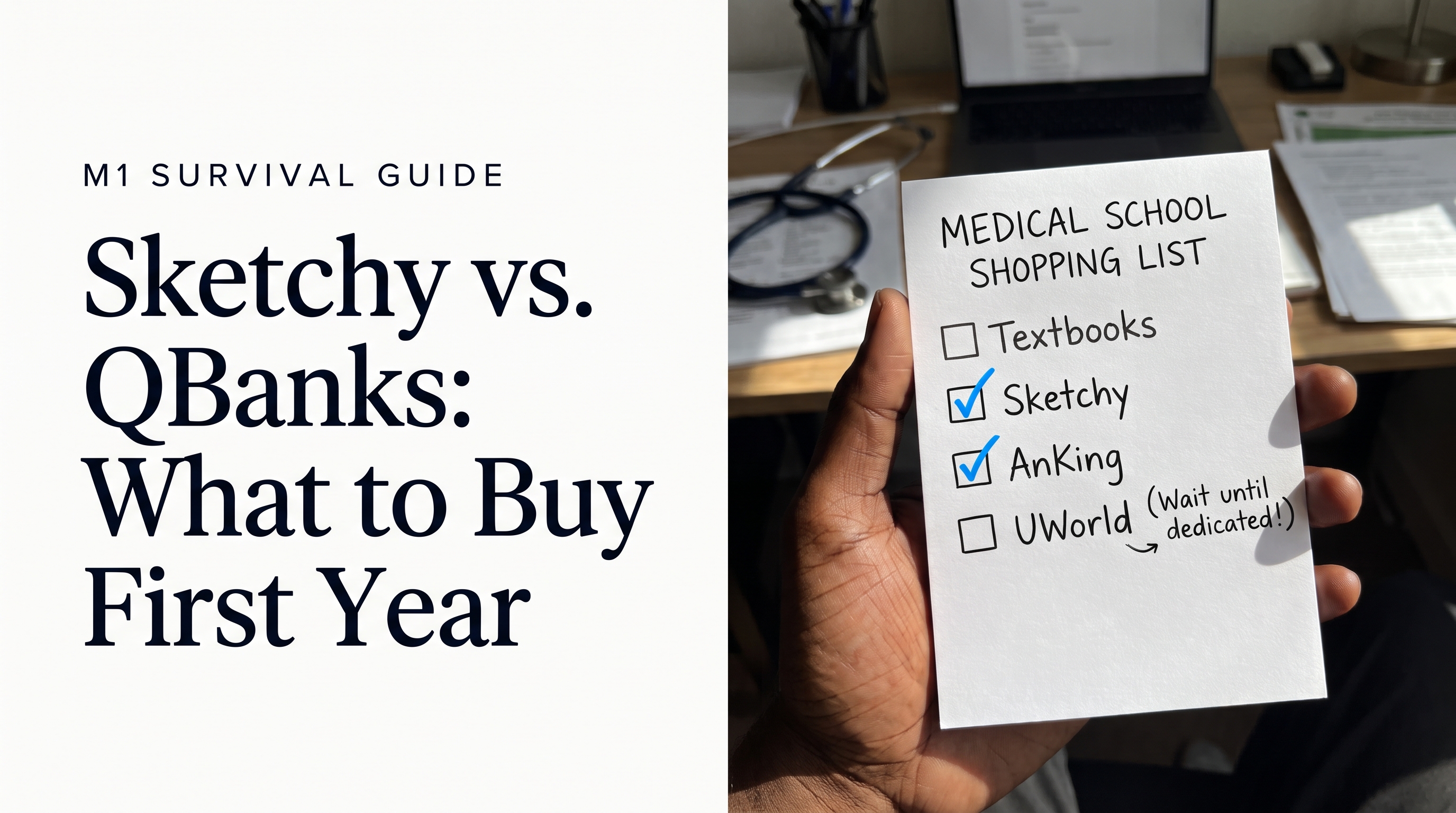
If you just started M1, your resource list is likely already out of control.Resources like Sketchy and AnKing keep coming up, and your group chat is debating several QBanks. Here's what each resource actually does.
What is Sketchy for?
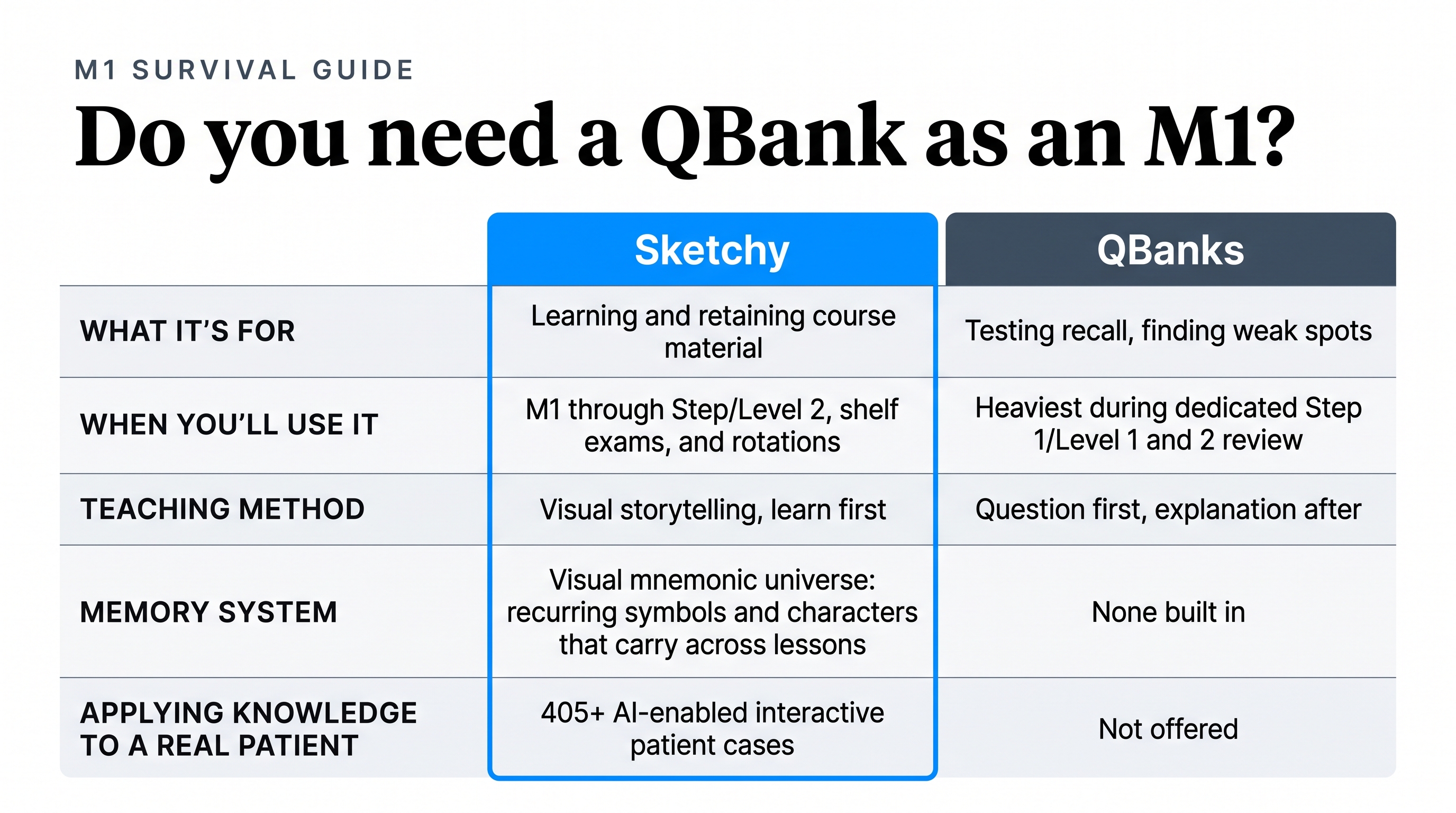
QBanks test what you already know. Sketchy is how the material got in your head in the first place. It's built to turn this week's lectures into something you remember without needing to re-read it five times, and it prepares you for the block exams you're taking right now, not just for the Step 1/Level 1 exam that's still a year or two away (although it does that too!).
What is a QBank for?
Most QBanks do fundamentally the same job. They hand you a large bank of exam-style multiple-choice questions and a detailed explanation for each one, so you can practice recall and find your weak spots.
- UWorld is the category leader: 3,600+ questions with explanation depth that functions almost like its own mini-lesson under each question, plus peer performance comparisons and strong analytics. Subscriptions are sold in 30, 90, 180, 360, or 730-day blocks.
- Bootcamp is a similar platform at a lower price point: 2,500+ Step 1/Level 1 questions, each linked to a short instructional video.
Both are genuinely good at what they do. Neither is built around a memory system, and that's the part that decides whether this week’s lecture will still be in your head on exam day.
What makes Sketchy different?
The Sketchy universe is an interconnected world of characters and symbols where every drug, bug, and disease has a visual hook. Immunology and Biochem, are where this matters most right now. You'll picture a scene, and recall the facts that come along with it.
Sketchy also comes with two things you'd otherwise go buy separately later:
- A QBank of its own: thousands of vignette-style and scenario-based practice questions, with explanations linked straight back to the Sketchy lesson that taught the concept, so a wrong answer sends you to the exact video lesson that fixes the gap.
- 405+ AI-enabled interactive patient cases: a way to actually apply what you're learning to a real patient scenario, building a differential and getting instant, personalized feedback on your reasoning.
What medical students tell us
Don't just take our word for it. Ask the more than 500,000 students who used Sketchy to survive their own firehose year. It’s the difference between memorizing and actually learning.
"Sketchy has helped me tremendously, especially in Immuno and Pharm. I've also used it for other courses to memorize complex topics like the coagulation cascade. I've already recommended it to incoming medical students, including my brother, who just started med school himself."
— Joel P., M1
"I started using Sketchy in my first year for micro, and it was love at first sight! I began watching the Pathophysiology videos, and they single-handedly got me through my first two years of medical school. It's also been a lifesaver for anatomy and physiology topics I had a hard time mastering on my own. Now that I'm studying for Step 1, it's been so easy to answer the questions. Honestly, I should shout Sketchy out on my MD diploma."
— Bianca Y., M2
"Throughout medical school, Step 1, Step 2, and now residency and Step 3, Sketchy has always been my #1 resource. I truly wouldn't be where I am today without it."
— Dr. Jake G., Resident
What this means for your study stack and budget
If you're optimizing for time and money as an M1, start with Sketchy, and layer in the AnKing deck through AnkiHub as soon as you're watching lessons regularly. It's built for the exams you have this semester, it continues to be useful as your coursework gets harder, and it already includes QBank-style practice and case-based application, so you're not paying twice for overlapping tools.
A dedicated QBank makes the most sense once you're closer to the actual Step 1 review, so you're not paying for a subscription window that runs out before you need it.
Either way, you don't need to decide on a QBank this week. You need something that gets you through this week's material, and that's the gap Sketchy is built to close first.
Start with the tool you'll still be opening in third year.
See how Sketchy covers your block exams, your Step 1 foundation, and your first taste of clinical reasoning, all in one place. Build a stack that lasts through Pharmacology and microbiology, Step 2, and beyond.
