


How to Study in Medical School: The 3-Skill System That Took One Student From Average to a 266



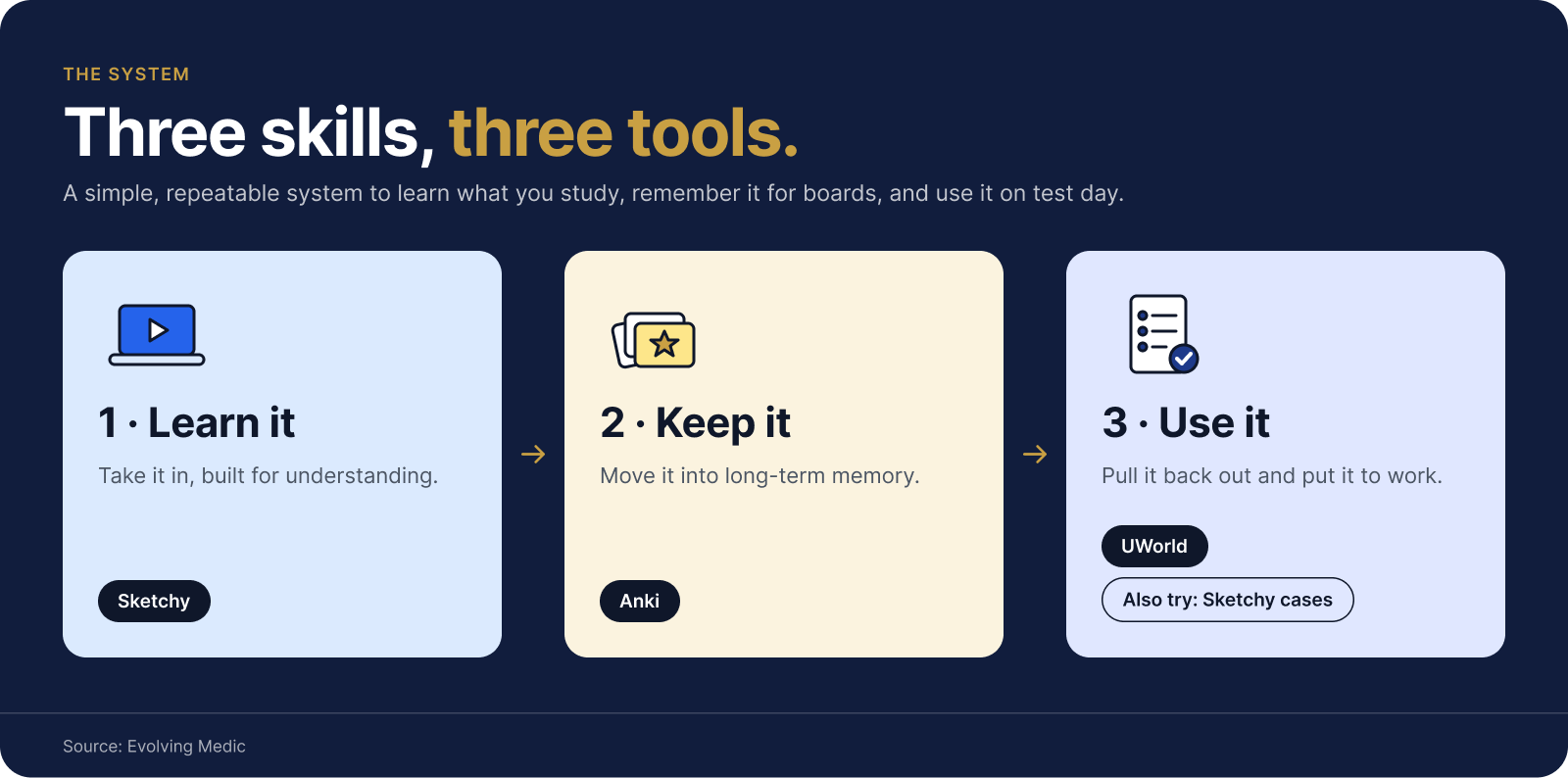
- Learning is a trainable skill. Dr. JR Smith’s study system trains three parts of it: learn new material until it actually makes sense, keep it with active recall and spaced repetition, and use it with timed, mixed practice questions.
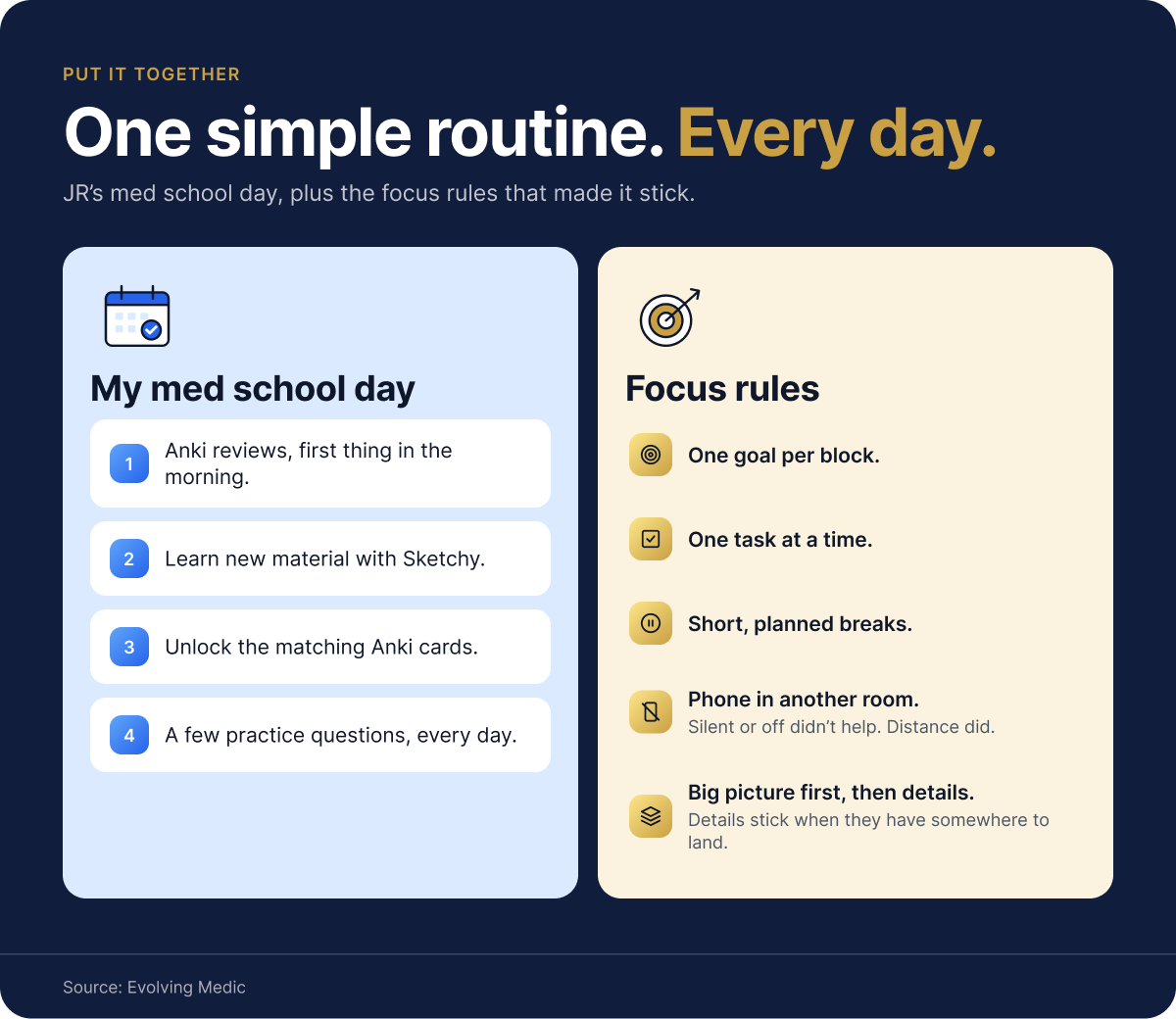
- Focus comes first. Set one goal per block, do one task at a time, plan short breaks before you need them, and put your phone in another room. Silencing your phone doesn't help, but distance does (Ward et al., 2017).
- Rereading feels great five minutes later. Self-testing wins a week later (Roediger & Karpicke, 2006). Anki combines self-testing with spaced review, and premade decks are tagged to Sketchy lessons, so you can go straight from sketch to flashcard.
- Every missed question comes from one of three gaps. A content gap means you didn’t know it. A question gap means you misread what they were asking. A fatigue gap means you knew it, but it was question 38 and your brain had clocked out. Reading the last line of the question first helps close the question gap.
- Keep your resource list short enough to use every day. Hoarding resources doesn’t count as studying. JR used the same system from Step 1 through Step 2 because complexity kills consistency.
Dr. JR Smith scored a 266 on USMLE Step 2 CK, above the 90th percentile at the time, after figuring out how to study in medical school the hard way. His scores didn't start there:
- MCAT, first attempt: 506
- MCAT, second attempt: 511
- First months of med school: overwhelmed and anxious
- USMLE Step 2 CK: 266
- Residency match: his first-choice program, orthopedic surgery at Mayo Clinic
"When you're studying hours and hours and hours and you're still not getting the grades that you want, it's defeating." - Dr. JR Smith
The turnaround started partway through his first year, when he changed how he studied. In a Sketchy webinar on October 22, 2026, JR walked through the system: treat learning as a skill you train, the same way an athlete trains. Learn new material for understanding (he used Sketchy). Keep it with active recall and spaced repetition (Anki). Use it with timed practice questions (UWorld). Then protect your focus and keep the whole system simple enough to run every day.
The athlete comparison comes from his own life. JR was a sprinter and long jumper at Duke when one bad landing dislocated his knee. He spent about a year researching how to recover, turning it into a daily routine, and adjusting as he went. The comeback, he said, "had absolutely nothing to do with talent." He made it back onto the runway, was named team captain, and later brought the same approach to med school.
By his own account, the new system also meant fewer hours studying and less stress. Here's how each piece of the system he credits for his 265 works, and the research it's built on.
Why don't most medical students have a study system?
Most medical students don't have a study system because nobody teaches one. In a survey of 279 first- and second-semester medical students in Brazil, published in 2026, 92% said they had never been taught how to study (Moreira et al., 2026).
That was JR's experience too: "We're told that we have to learn a ton of information, but we're never told how."
So you copy whatever upperclassmen, classmates, or someone online swears by. In a 2024 study of students preparing for the USMLE, about half used three or more review resources covering the same content. Using more resources wasn't linked to higher scores (Ranabhat et al., 2024). A pile of resources isn't a system.
"We let [the scientific literature] guide the way that we manage patients. And we should be honestly thinking about our own learning the same way."- Dr. JR Smith
The research on what does work is pretty clear. A major review of 10 common study techniques rated practice testing and spaced practice as high utility. Rereading, highlighting, and summarizing landed at the bottom (Dunlosky et al., 2013). JR built his system around the top of that list, organized as three skills: learn it, keep it, and use it.
How do you train your focus for studying?
You train focus for studying by simplifying each study block and getting your phone out of the room. It matters because, as JR told attendees, "you can't learn what you don't pay attention to." When researchers observed students studying, they lasted less than 6 minutes on task before switching away, usually to tech (Rosen et al., 2013, a study of middle school through university students). Med students do the same thing: 61% of their self-tracked study sessions included off-task time (Furness et al., 2025).
JR's four rules for every study block:
- One goal per block. Decide ahead of time what you'll study and what you'll finish. Across 94 tests, deciding when, where, and what in advance improved follow-through (Gollwitzer & Sheeran, 2006).
- One task at a time. Every switch between tasks costs you time and accuracy (Rubinstein et al., 2001).
- Short, planned breaks. Brief breaks kept attention from fading over a long task (Ariga & Lleras, 2011). JR is a big Pomodoro fan.
- Phone in another room. JR calls this one the biggest. In one study, students with their phone in another room scored highest and students with it on the desk scored lowest. Silencing it or switching it off didn't help (Ward et al., 2017).
"That urge and that discomfort is exactly what training your brain is supposed to feel like." - Dr. JR Smith, on keeping your phone out of reach
JR started with 10 to 15 minute focus blocks and built up to 90 minutes over time.
What's the best way to learn new material in med school?
The best way to learn new material in med school is to start with the big picture, then add the details. Try this first. Read the paragraph below once, at normal speed:
It goes faster if you start the night before. Separate everything by how it behaves, not by how it looks. Some pieces need cold, some need heat, and a few should never meet at all. Too much at once and nothing comes out right. Afterward, check each piece before you put it away, because one mistake shows up everywhere.
Simple words, and still hard to follow. Now read it again knowing the topic is doing laundry.
Bransford and Johnson found this effect in 1972. Context given before reading boosted comprehension and recall, and the same context given after barely helped. (The passage above was written for the webinar in the style of their materials.) In medicine, the big picture is the mechanism, the physiology, the story behind the disease. Details stick when they have somewhere to land.
That gives your main learning resource two jobs: build the foundation and make the details stick. For JR, Sketchy did both, and it was easy to stay focused on: "I grew up watching Cartoon Network and Nickelodeon. So what's easier to focus on than watching cartoons?"
- The foundation. Every Sketchy lesson is a visual story, covering physiology, pathophysiology, micro, pharm, and more, that shows how it all connects. Facts tied together were remembered better than the same facts on their own (Bradshaw & Anderson, 1982).
- The details. Every fact gets a place in the scene. In Sketchy's HIV lesson, a white wizard stands for the virus, his robes for the viral envelope, and his conical hat for the conical capsid. In medical students, story-based visual mnemonics beat reading the text for up to 4 weeks, with faster recall (Abdalla et al., 2021).
Those studies tested the methods, not Sketchy itself. JR's own proof comes from residency.
"I actually still remember scenes that I watched over five years ago, and they still actually help me take care of patients as a resident, even though I'm in ortho." - Dr. JR Smith
How do active recall and spaced repetition work together?
Active recall and spaced repetition work together by making you pull information out of memory right before you'd forget it. Active recall means retrieving an answer instead of looking at it again. Spaced repetition means reviewing at growing intervals, timed so each memory fades more slowly. Both help on their own, and combined they work best.
Active recall. In a classic study, students either reread a passage or closed it and wrote down what they remembered. Five minutes later, the rereaders were ahead (81% vs. 75%). A week later, the self-testers won (56% vs. 42%) (Roediger & Karpicke, 2006). Rereading wins tonight, and testing wins the exam.
Both together. In one study, students got the same 24 minutes to learn anatomy. Students who crammed it into one day recalled 13 items a week later. Spreading it over a week with rereading raised that to 25. Spreading it over a week with self-testing raised it to 34 (Dobson et al., 2017).
How does Anki help with active recall and spaced repetition?
Every Anki card makes you pull the answer out, and the algorithm brings each card back right before you'd forget it. You don't have to make the cards either. Premade decks like AnKing are tagged to Sketchy lessons, so JR watched a lesson and then unlocked the matching cards.
A 2026 systematic review found regular Anki users scored 4 to 13 points higher on Step 1 than minimal users across three studies. That's an association, not proof of cause (Frappa et al., 2026). JR is upfront about how it feels: "Nobody enjoys the process of doing Anki." Even its biggest fans, himself included, "don't necessarily like it. They just recognize the evidence behind it."

How do you get better at board-style questions?
You get better at board-style questions by doing a lot of them under real test conditions: timed, and mixed across topics. You can read everything about swimming and still sink the first time you get in the pool. "Being a good test taker is a skill," JR said, "and like every other skill, it gets better with practice." JR did his in UWorld.
The biggest gains come from reviewing your misses the way JR's track coach reviewed film of his jumps. JR sorts every miss into one of three gaps:
Content gap: "I didn't know it."
The fix: Learn it with Sketchy. Keep it with Anki.
Question gap: "I knew it, but misread or misapplied it."
The fix: Change the order you read the question in.
Fatigue gap: "I knew it, but missed it late in the day."
The fix: Build endurance and protect your momentum.
How should you read a USMLE question?
Read a USMLE question from the bottom up. Most people start at the first word, but JR flips the order:
- Read the last line. That's the actual question.
- Skim the answer choices.
- Read the stem, hunting for what matters.
Try it on this practice question, written for the webinar in the style of board questions:
A 24-year-old woman comes to the emergency department 2 hours after injuring her right knee playing soccer. She says she planted her foot and pivoted, felt a pop, and could not keep playing. The knee swelled within an hour. She has asthma treated with an albuterol inhaler and drinks alcohol socially. Temperature is 37°C, pulse is 92/min, and blood pressure is 124/78 mm Hg. There is a large effusion. With the knee flexed to 30°, the tibia shifts forward on the femur with a soft end point. Which of the following structures is most likely injured?
A. Anterior cruciate ligament · B. Lateral collateral ligament · C. Medial meniscus · D. Patellar tendon · E. Posterior cruciate ligament
The last line tells you you're looking for an injured structure, and the choices tell you it's in the knee. Now the asthma, the alcohol, and the vitals fall away. What's left stands out: she planted and pivoted, felt a pop, swelled within an hour, and has a positive Lachman test. The answer is A, the anterior cruciate ligament. "It was the same paragraph," JR said, "but this time I read it with a purpose."
Spotting what matters and ignoring the rest is a skill you can train. Sketchy Cases is built for it. You take the history, build a differential, work up the patient, and get feedback. The cases are newer, and JR didn't hide his envy: "They didn't have this when I was in medical school. So I'm jealous of you guys." It's also good practice for applying what you know in a clinical setting, which is what Step 2 CK tests.
How do you avoid fatigue on Step 2 CK?
You avoid fatigue on Step 2 CK by building endurance before test day and protecting your momentum during it. Step 2 CK is a full day of testing (check usmle.org for the current format). JR trained for it the way a distance runner builds mileage: one timed 40-question UWorld block, then two, then three. By the end of dedicated prep, he was doing more than 200 practice questions a day.
Momentum matters too. JR noticed his misses clustered around the questions he'd stared at, and one long stare tended to lead to another. So he made a rule. After reading the last line, the choices, and the stem, if he felt the urge to reread before answering, he picked his best answer, flagged it, and moved on.
"If you're running and stopping and running and stopping over and over again, at some point you're just going to stop. And taking a test is no different." - Dr. JR Smith
What does a simple med school study day look like?
JR's med school study day had four steps, all with his phone in another room:
- Anki reviews, first thing in the morning
- Learn new material with Sketchy
- Unlock the matching Anki cards
- A few UWorld questions every day (many more during dedicated Step 2 CK prep)
That's three tools for three skills. He kept the same system for Step 1 and Step 2 instead of switching it up, because every new piece adds complexity. "It is super hard to do anything consistently if it's complex." The science behind it is complicated. Your system can stay simple.
Get Sketchy's free 6-week Step 1 study calendar, which pairs Sketchy lessons with your schedule.
Does teaching others help you learn?
Teaching what you know, JR said, is "one of the most gratifying and fulfilling things. And it also actually helps you remember the things that you're learning." JR built Teach As You Learn (TAYL), a community where students learn from mentors one step ahead and mentor students one step behind. You can find more of his work at evolvingmedic.com.
How do you start building your own study system?
A short list of resources and a daily plan you'll actually follow is enough. First-years can pair this with our guide to building strong study habits, which covers time management, previewing material before lectures, and choosing where to study. Start with the first skill: try Sketchy free and see how each lesson gives you the big picture and the details in one place. When you're ready to practice using what you know, Sketchy Cases comes with a full plan or on its own.
