


USMLE Step 2 CK Study Guide for MS3 Students


Keep up with a question bank and content review during each clerkship so dedicated isn't starting from scratch.
Build your dedicated study schedule backwards from your test date.
Lock in your CCSSA practice exam dates first, then days off, then fill in daily question counts, flashcards, and content review prioritizing the clerkships you finished earliest.
Take your CCSSA practice exams like it's the real thing. Neutral location, phone off, real-time breaks, real food. Simulation builds stamina and thoroughly reviewing every question is where the actual score gains happen.
The United States Medical Licensing Examination (USMLE) Step 2 Clinical Knowledge (CK) is a comprehensive exam that focuses mainly on principles from your core clerkship year of medical school. It emphasizes one’s ability to apply medical knowledge, skills, and understanding of clinical science essential for the provision of patient care under supervision, with an emphasis on health promotion and disease prevention.1 Most medical students take this exam at the end of their third year (MS3) after completing clerkships like internal medicine, surgery, pediatrics, and family medicine, to name a few. Unlike USMLE Step 1, which most students take as a cumulative exam after the first two years, studying for your end-of-rotation examinations in MS3 is studying for Step 2. And, since Step 1 comes before Step 2, you will already feel familiar with the exam format, timing, and testing center rules before stepping foot on test day.
There is a caveat and a historical point to note before we proceed:
- This is written from the perspective of a United States M.D. student, so the timing of your exam may vary depending on your institution. Some schools will take Step 1 and Step 2 back-to-back after MS3 or some of you reading this are foreign medical graduates taking Step 2 on a different timeline.
- On January 26, 2021, the USMLE Step 2 Clinical Skills (CS) was discontinued. This was a separate component of the Step 2 series that included in-person clinical examinations such as history and physical taking. For the purpose of this guide, any reference to “Step 2” implies the currently tested Step 2 CK.
Key Principles
Here are a few key principles to fall back on should you ever feel bogged down in preparing for Step 2:
- It is simply another standardized exam. For examinees from a US medical school in 2023-2024, the pass rate was 97%.2 Now, where things differ from Step 1 is that Step 2 provides a three-digit score. We will discuss this more later.
- Lean on what worked for Step 1. Again, the format is eerily similar and while the exam focuses more on the clinical aspect of medicine, you will still have Step 1-esque questions and topics. Many students change how they study for clerkship as compared to preclerkship but, that doesn’t mean all of your strategies are out the window.
- Stamina. Once again, similar to Step 1, this is a long exam. You cannot feasibly walk into test day without having taken a practice test because, unless you are a superhuman, you need to build up your stamina. Remember: Your brain is just like a muscle, and marathon runners don’t just wake up one day and decide “I’ve never ran before but 26.2 miles sounds like fun this morning!”
- There are a thousand and one different ways to study to pass this exam. You already know this. But, it is important to remember, especially if you begin comparing yourself to your classmates or those on the internet. The same advice I give for Step 1 is true here, too: Make a buddy you trust and can talk openly and honestly about the exam with and then that is it. Stay off Reddit, SDN, etc. You got this!
- Lastly, study for this exam not just to pass or for your personal satisfaction, but for your future patients. One of my favorite quotes of all time is “common things are common.” We love looking for zebras in medicine but, the USMLE question stems— and your patients— rarely present that way. We learn illness and disease scripts for a reason, and now we expand upon that to include workups that are ubiquitous standard of care treatment regimens. After all, we should all be striving to practice evidence-based medicine.
MS3 Year (pre-Dedicated)
During MS3 year, while you are waiting for that next case to be ready in the operating room, there are some things you can be doing to prepare for Step 2.
Examinations
As mentioned before, most medical schools will administer an end-of-rotation exam, commonly known as a “shelf” exam. These are clerkship examinations provided by the National Board of Medical Examiners (NBME) and allow schools, and yourself, to make comparisons to other students who have taken the same examination despite differing clerkship opportunities. Your focus during MS3 year should be these exams. These questions come from the same test writer as Step 2, so even though they are rotation-specific, the style and feel will be extremely similar to what you will see on test day. These exams also give you great insight into what your weaker subjects may be. For Step 1, maybe you were like me and were a bit lacking in pulmonary physiology and general neuroscience. But, when it came to Step 2, I quickly learned that I had remedied my misunderstandings in pulmonary physiology and replaced that with my new weak spot, OB/GYN. Sadly, my shortcomings in neuroscience continued into Step 2. Had I not taken these exams, I wouldn’t have known what rotations I needed to study harder for when it came time to review for Step 2. See below for more information on how to use the officially licensed NBME practice exams to prepare for your end-of-rotation exams.
Studying
To take these shelf exams throughout MS3, you need to study for them. First and foremost, let’s focus on content. I can guarantee you— and will happily bet you the contents of my savings account (spoiler alert: not much there)— that your 4 weeks in a family medicine clinic will not cover everything that is testable on these exams. Point being, there needs to be some outside studying done in combination with seeing patients. This is where I recommend you fall back on what worked during pre-clerkship. Of course, Sketchy is at the top of the list because, even more than MS1 and MS2, time is limited in MS3. So a resource that distills information down into memory palaces and only takes 10 minutes is one that should be utilized. Of note, this is likely going to be a combination of following the clerkship-specific Sketchy content as well as refreshing yourself on the basic sciences (no, the macrolide sketch never does go away). Regardless of what resource you choose, you need something on the “content” side to reinforce what you see in the clinic and provide the basics and background necessary for a condition you have never seen before where the exam is now asking you how to treat it!
Along with content, you also need practice questions. Again, this is no different from pre-clerkship. Many students will use UWorld; however, it’s good to keep in mind that there are plenty of other question banks out there. So, be sure to do your practice questions throughout the clerkship as this will help with your practice exams, shelf exams, and honestly, when you’re seeing patients, too.
Making a schedule
“Konnor told me I need to go to clinic, see patients and learn from each one, go home, do content review, do practice questions, take practice tests, AND still be a functioning human being… HOW?” I know, I know. It sounds crazy, but this is the benefit of being a third year medical student: You know what works and what doesn’t when it comes to studying. Yes, absolutely, the time requirements are different and studying clinical concepts can feel quite different than the basic sciences, but the framework is there.
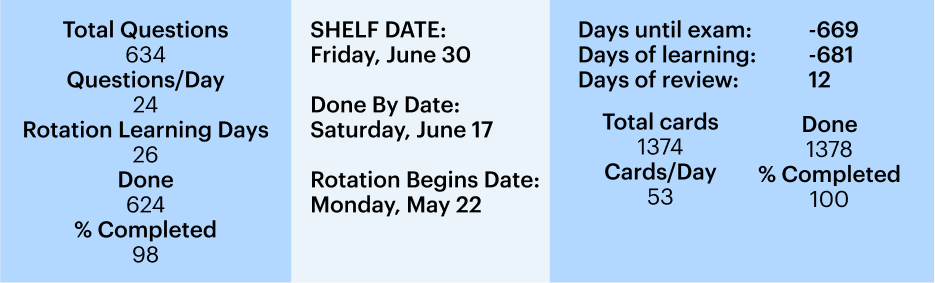
Here’s what worked for me. I had a master Google Sheets document that tracked all things MS3 for me. It was broken down by clerkship. Let’s use pediatrics for example: on the sheet I would keep track of: rotation start date, date of end-of-rotation exam, number of “learning days” (these were days I counted as having ample opportunity to study and do questions), number of questions in the pediatrics UWorld section, number of associated Anki cards, a practice exam tracker, and a list of all of the pertinent outside resources for the rotation (e.g., what Sketches to watch, what free resources should I peruse, etc). This may seem like overkill to many of you, but for me, I had the exact same thing during MS2 and it brought me comfort to have the familiarity when venturing into MS3. Three important variables to account for:
- Questions per day. You are going to take the total number of UWorld questions and divide them by your self-proclaimed “learning days.” This will give you the number of questions to do per day to be done by your shelf date. For me, it was 634 questions over 26 days meaning I needed to do 24 questions per day to stay on pace.
- Anki cards per day. This follows the same format as above. I was doing roughly 53 “new” cards per learning day.
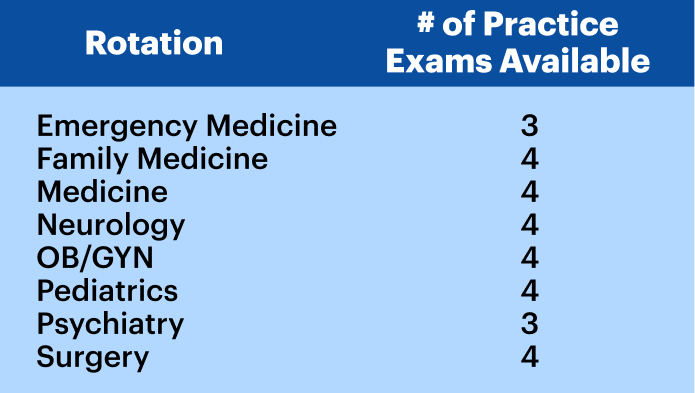
- Practice exams. As mentioned above, the NBME, the institution that also writes your end-of-rotation “final exam,” also created practice exams that are eerily similar to the final exam. You can find these online via the NBME Self Assessments portal. Before the rotation officially starts, schedule these on your personal calendar. For me, pediatrics was a six week long rotation and with four practice exams, you have to start early. I always tested on Sunday mornings and took one per week. So, Sunday of week two, week three, week four, and week five were my exams. Then, the Friday of week six was my shelf exam. This gave me ample time to take the exams and acquire knowledge in between. Please take all available practice exams before taking the shelf exam.
Lastly, there’s one component to all of this that I cannot spell out for you, but only comes with experience: time management. How are you going to eat well, sleep eight hours, go to clinic, do 24 practice questions, review 53+ Anki cards, and watch a few Sketches each day? I do not have an answer to this, but I am a big proponent of being intentional, remaining on-task, limiting distractions, and scheduling things out. If I were to rank your mental and physical health as the number one most important thing (it is!), then number two would be your in-person interactions with patients. This is my gripe with MS3, and I will save you my soapbox, but we have to balance studying for exams with day-to-day on-the-job learning. In a perfect world, you could put 100% of your effort into seeing and learning from your patients. But, alas, this just is not true for us medical students.
Dedicated
Making a schedule
Alright friends, we made it. Our ± seven core clerkships are done and you hopefully have had some time to stop and catch your breath. Most medical schools will provide you with some form of “dedicated” time out of the hospital to study for USMLE Step 2. This is not true for all, so please adjust the information in this section to your unique situation.
Regardless if you have this Dedicated period or not, I want to stress the importance of making a schedule for tackling Step 2. Similar to Step 1, there are mountains of content to review and brush up on before taking the test. Thankfully, if you kept up with your studies during the year, this will be a less daunting task. If you made a schedule for Step 1 studies, great! Repurpose it to fit Step 2. If you haven’t made one before, here are a few tips:
- Priority #1 is picking a test date. Put this date on every calendar imaginable. It will keep you accountable.
- Then, work backwards. There are seven NBME licensed practice exams for Step 2. I would recommend taking no more than two per week, so work backwards to schedule these (write them down on your calendar) so you know what days you are taking practice exams (these are all day long affairs).
- Days off come next. Have a wedding to attend? Religious obligations? Just plain tired of studying? Write these down too.
- Now we flesh out the rest of the schedule with things like practice questions per day, flashcards, reviewing Sketchy, using the Sketchy cases product to reinforce illness scripts and disease workup and management, and going back to your clerkships and remembering what you struggled with versus what you knew like the back of your hand. I recommend focusing on the clerkships that are the oldest for you, as these are likely the ones that need more reviewing than the more recently completed ones. With that being said, give yourself time to deep dive into the clerkship topics that really gave you difficulty. In my opinion, compared to Step 1, the relearning is easier for Step 2 and you can afford more deep-dives versus surface-level understanding.
Practice exams
As mentioned above, practice exams are incredibly important. These exams, now called Comprehensive Clinical Science Self Assessments (CCSSA), are your key to achieving a great Step 2 score. I sound like a broken record but it really is true, these are expired Step 2 questions written in the same format and tone as what you will see on test day. They are the best insight into the test writers’ minds. They currently cost $62 USD per exam and consist of four sections of 50 questions each (200 total). Try to take these exams in a simulated fashion. That is, take them in a neutral third party location (not comfy on your couch, I am sorry), start in the morning, turn your phone off, plan what food and snacks you will have, simulate taking breaks as you would on test day, etc. This is all things you were hopefully doing when prepping for Step 1. So again, whatever worked for that is what you should start with here! The biggest key as you already know is reviewing these exams. Give yourself time to thoroughly dissect the questions, review why certain answers were incorrect, and write down a sentence or two about the key concept of the question.
Resources
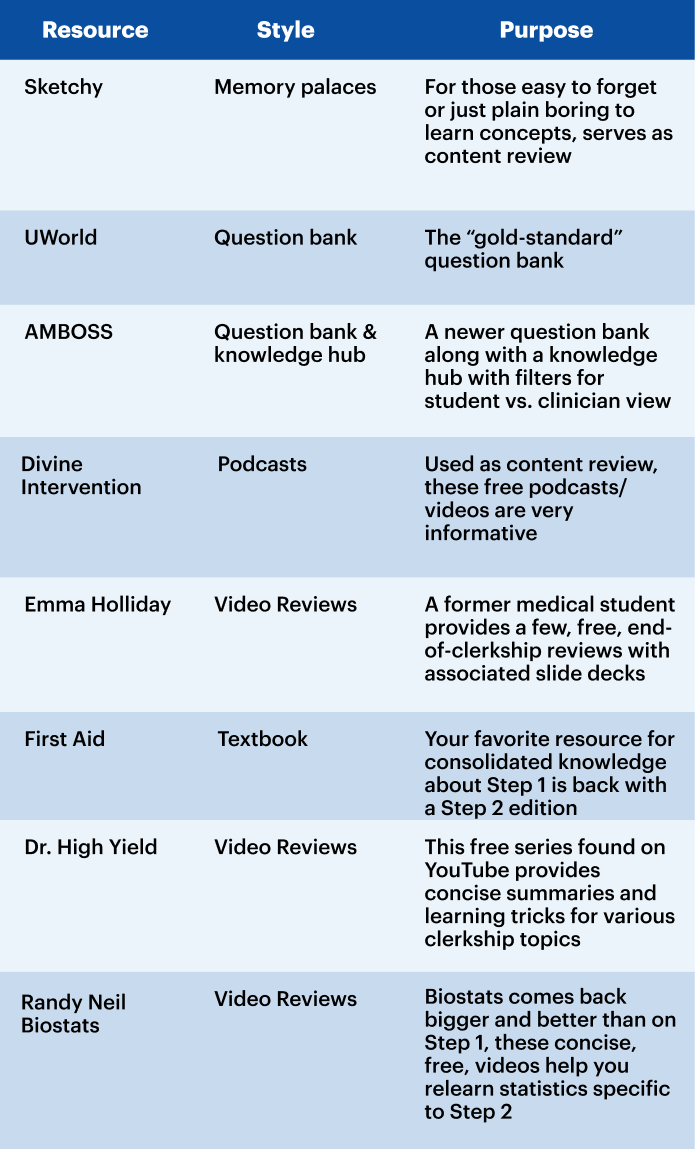
Here is my personal list of paid/unpaid resources that you can consider using for Step 2. Of note, I receive zero kickbacks for linking any of these and this list is not comprehensive. And, us here at Sketchy want you to know what is available, too.
Test Day
Ins and Outs
The following bulleted list of important things to note/remember is my exact same as USMLE Step 1 which you may, or may not, have already taken:
- Recommend going to the testing center the day before at the exact time you are scheduled for the next day, find parking, walk in, see where the bathrooms are, plan where you will take your breaks.
- All you need on test day is your license/passport & your scheduling permit (either print out or a photo on your phone).
- Every center is different but we had lockers both small and large (but not large enough for a backpack— just large enough for like a tote bag)
- I'd recommend being there at least 30 min earlier
- You will sign a sheet, show them your license/form of ID, write down your scheduling number on the whiteboard, get a locker key, and then you can either go right in and get started, or you can relax for a bit as long as it is before your test time.
- You will do two sets of fingerprints (just each index finger), take a photo, sign one more form, empty/show your pockets, show your sock line, and get wanded.
- You’ll then be escorted to your desk and shown the headphones (one for audio and one for noise canceling– they do not provide earplugs). They log you into the computer, and then the tutorial immediately begins so be ready.
- Then, when you hit "take a break" between sections, just get up and take your ID/key, acknowledge the proctor that you are taking a break, and do your thing. Once you’re finished, you’ll come back to your proctor and show them your pockets/get wanded and you are good to go.
How I did my breaks
- Overall: 45 minutes of guaranteed break time. Add 15 minutes if you skip the tutorial; any time you don’t use at the end of a block adds onto your break time.
- In between block 1 and block 2 was a 2-3 min break at the computer where I closed my eyes, took deep breaths, and recited positive affirmations. I did this to bank time for later since I knew I was full of adrenaline in the morning.
- Break between 2 and 3 was ±7 min to eat a protein bar and some water (I also made sure to walk around, stretch, and breathe).
- Between 3 and 4 I went to the bathroom and drank more water, ±5 min.
- Between 4 and 5 was my "lunch" so I took ±20 minutes and went outside to sit in the sun (scope out a nice bench the day before) , ate a PB&J and had a Spindrift.
- Between 5 and 6 I went to the bathroom, had some nuts and a dark chocolate peanut butter cups (I love chocolate and needed a pick me up)
- Between 6 and 7, I did the same as above.
- Between 7 and 8 I used whatever time was remaining to take a walk outside and drink water.
The actual exam
The exam begins with a tutorial section which is the exact same as Step 1. You can use this time for whatever you’d like, such as writing down equations. You then face the daunting task of eight blocks of 40 questions each. Of note, this is one block longer than Step 1 and technically you can get less than 40 questions per section (I had a section with 38) but never more than 40.
Post-Exam
Congrats! You did it! NO MORE LICENSING EXAMS DURING MEDICAL SCHOOL! Here are some post-exam do’s and don'ts:
DO
- Celebrate! You earned it after conquering that beast of an exam
- Google questions (trust me)
- Whatever you want after your exam. Some will want to party, some will want to nap, do what YOU want and/or need!
DON’T
- Freak out. It will all be okay. You spent three (or more) years acquiring knowledge for this test, I guarantee you no matter the score, you did your best.
- Confide in that family member or buddy about how the test day went and what your raw and unfiltered emotions are.
- Don’t perseverate! There is literally nothing you can do after you hit submit.
Score interpretation
The USMLE Step 2 examination, unlike Step 1, provides a three-digit score. This score will be plotted on a bar graph showing where you fall compared to examinees in a similar timeframe. Similar to Step 1, it also provides you with a few pages of subject-specific information comparing how you did based on discipline, system, or task. Once Step 1 was converted to pass/fail scoring, increased emphasis was placed on the Step 2 score since it provides a way to stratify residency applicants. You likely already know what score you are aiming for but, as a friendly reminder, you are more than your three digit score. Your intended speciality will be lucky to train you.
Final Advice
If you’ve made it this far, thanks for your time and attention! When preparing for Step 2, fall back on your trusted methods. After all, you’ve made it this far. Don’t forget about your physical and mental wellness during MS3 and Step 2 studying. And, despite whatever that score report spits out at you a month or so after taking the exam, know that you are so much more than a three digit score. I believe in you!

