


How to Review MCAT Practice Test Results Like a Pro




Reviewing MCAT practice test results like a pro means treating the review session as seriously as the exam itself. Pattern identification, category-specific wrong answer analysis, and updating your study plan based on what the data actually shows are the habits that separate students who improve from students who plateau.
A full-length, realistic MCAT practice test is like a thermometer: it measures your “MCAT aptitude” at a given moment in time. The idea is, if you had taken the real MCAT today instead of a practice test, that’s the score you would have gotten, or very close to it. This is especially true for the “official” practice tests released by the AAMC (the testmaker), but there are many other well-calibrated practice tests out there as well.
Thermometer analogies aside, if your temperature could also be an MCAT score, seek medical attention immediately.
For most MCAT practice tests you take, you’ll be glad it wasn’t your real score. So after taking a test, the most important step is to carefully analyze your results and ask “What could I have known, or what could I have done in the moment, to score better?” And if you’re a Sketchy MCAT student, you might also ask “What lessons could have helped me through that tough spot?”
How to Ask Yourself Those Questions
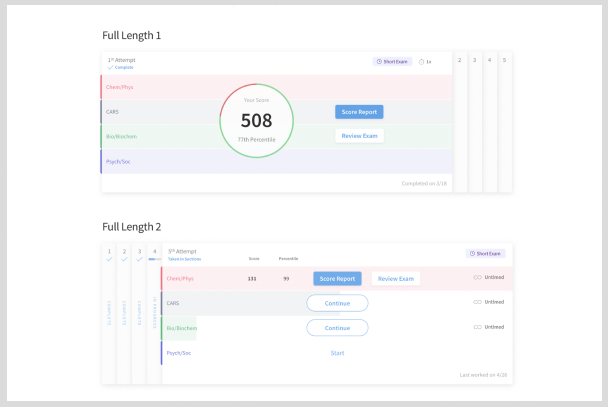
Many MCAT resources and prep providers offer analytics that can help identify your strengths and weaknesses based on MCAT practice test results.
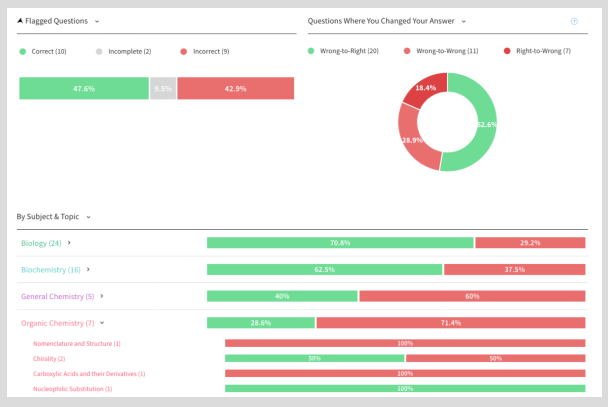
Blueprint’s MCAT results platform
These tools aren’t your only options—many students structure their own MCAT practice test reviews using spreadsheets or handwritten notes—but what’s ultimately important is the information you bring to the review. Make sure you consider the following for every one of your MCAT practice tests:
- Which passages were easy and hard for you to understand as you read them?
- How did your time management work out for each section – did you finish early, finish right on time, or run out of time?
- For every question you got right, did you get it right for the right reasons? (If not, and you just got lucky instead, then consider that a “wrong answer” instead).
- For every question you got wrong, and for any question you got right through sheer luck, what could you have done differently that would have put you on the right track?
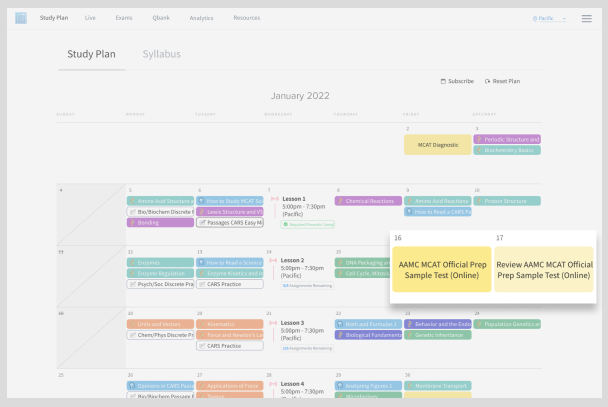
It’s important to do this review soon, too! You should review your MCAT practice tests the day after you take them, or two days after at the absolute most. Any longer than that and your memories of what it was like in the moment will fade too much to be useful.
Every one of these info sources is a treasure trove, but the last one—an analysis of every question you missed—is especially important. It can be a lengthy exercise, especially during the early stages of prep. But as you list out the reasons you got questions wrong, patterns will immediately emerge.
Understanding Your Own Bad (Testing) Habits
There are many reasons you might’ve got a question wrong—maybe you were just missing a topic area, or were moving too quickly, or got stuck in the details and ran out of time. Once you notice these patterns, write them down. Literally, write them down on a piece of paper. These patterns, and your behavioral changes that will fix them, are what need to stick in your head, and research has shown that writing notes by hand leads to better retention than only writing them with a keyboard. Then, when you review your next MCAT practice test, look back at your list of patterns and see if you learned and applied your lessons.
Every Wrong Answer Is An Opportunity
The essence of good test review is realizing that your own MCAT practice test results are a lot like any other study resource. The full-length MCAT you just took has hundreds of questions, usually paired with expertly-written explanations… plus, unlike flash cards or textbooks, it’s fully customized to your strengths and weaknesses already! It’s already identified the kinds of questions you’re more likely to get right and wrong…because you just took the test and literally got them right or wrong.
This attitude and approach to test review can be one of the most liberating and motivating ways to persevere through the toughest stages of MCAT study. 100 questions you just got wrong are, in truth, 100 questions you can get right next time and on test day.
