Practice the kind of thinking that EORs, OSCEs, and the PANCE test before you have to do it for real.

Build your DDx, make mistakes, and walk into rotations ready. No grade, no preceptor, no patient on the line.

Inside a case

How a Sketchy case unfolds

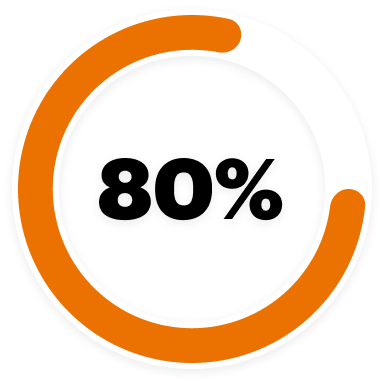
The research is clear: clinical exposure before boards means deeper understanding and higher scores.¹ ²
¹ Jurich D, et al. Acad Med. 2019;94(3):371–377. ² Daniel M, et al. Acad Med. 2017;92(11S):1515–1524.
See it in action

Swipe to explore a case

Sketchy cases get you ready for the big moments: presenting on rounds and taking Step 2. You take the history, narrow the differential, and decide how to manage your patient. The same reps you'll run in real life, minus a real life on the line.
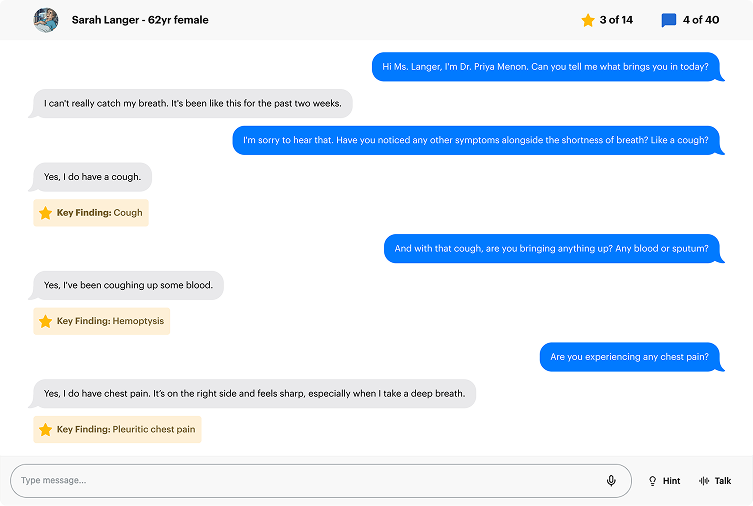
01 History & Physical

Get to know your patient.

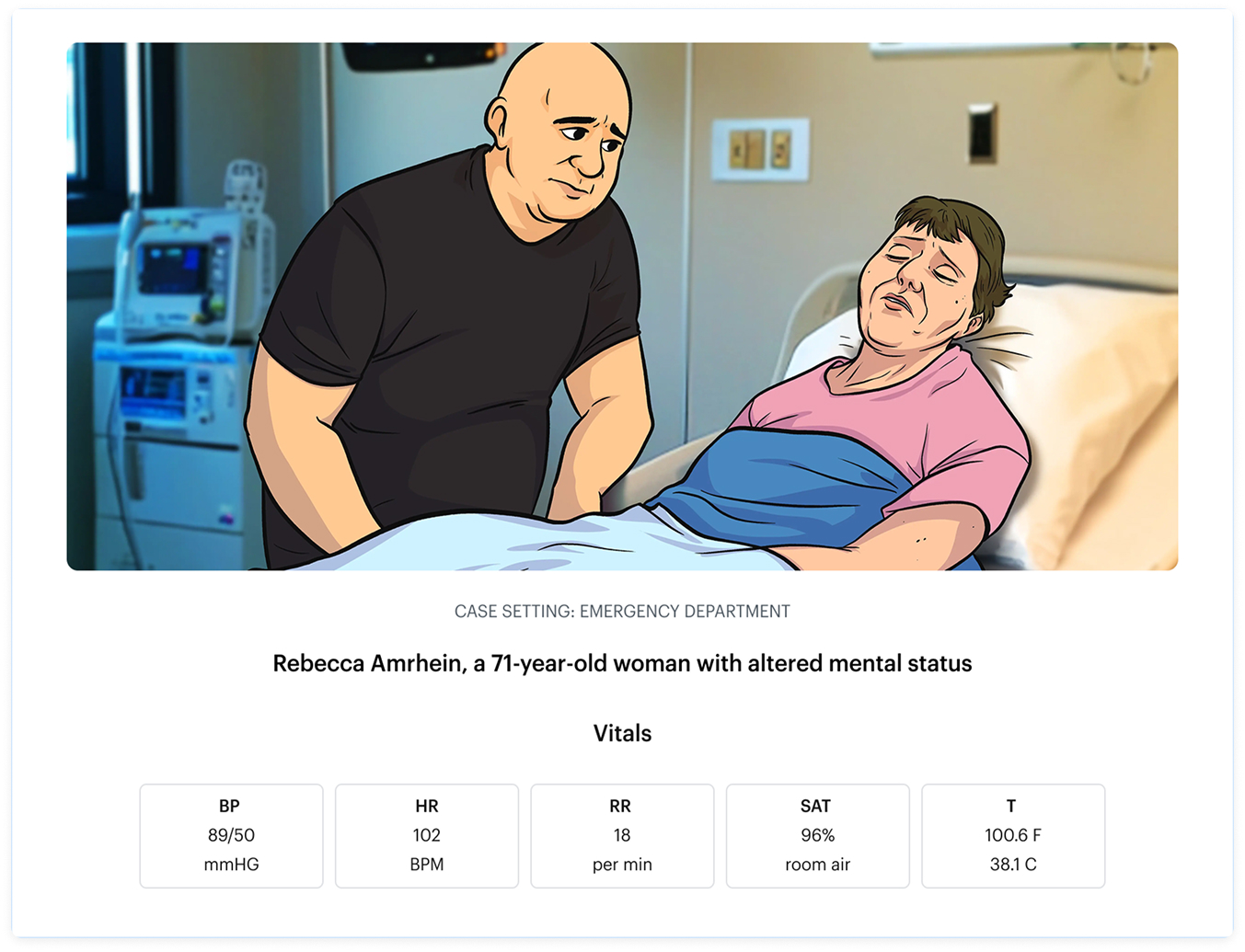
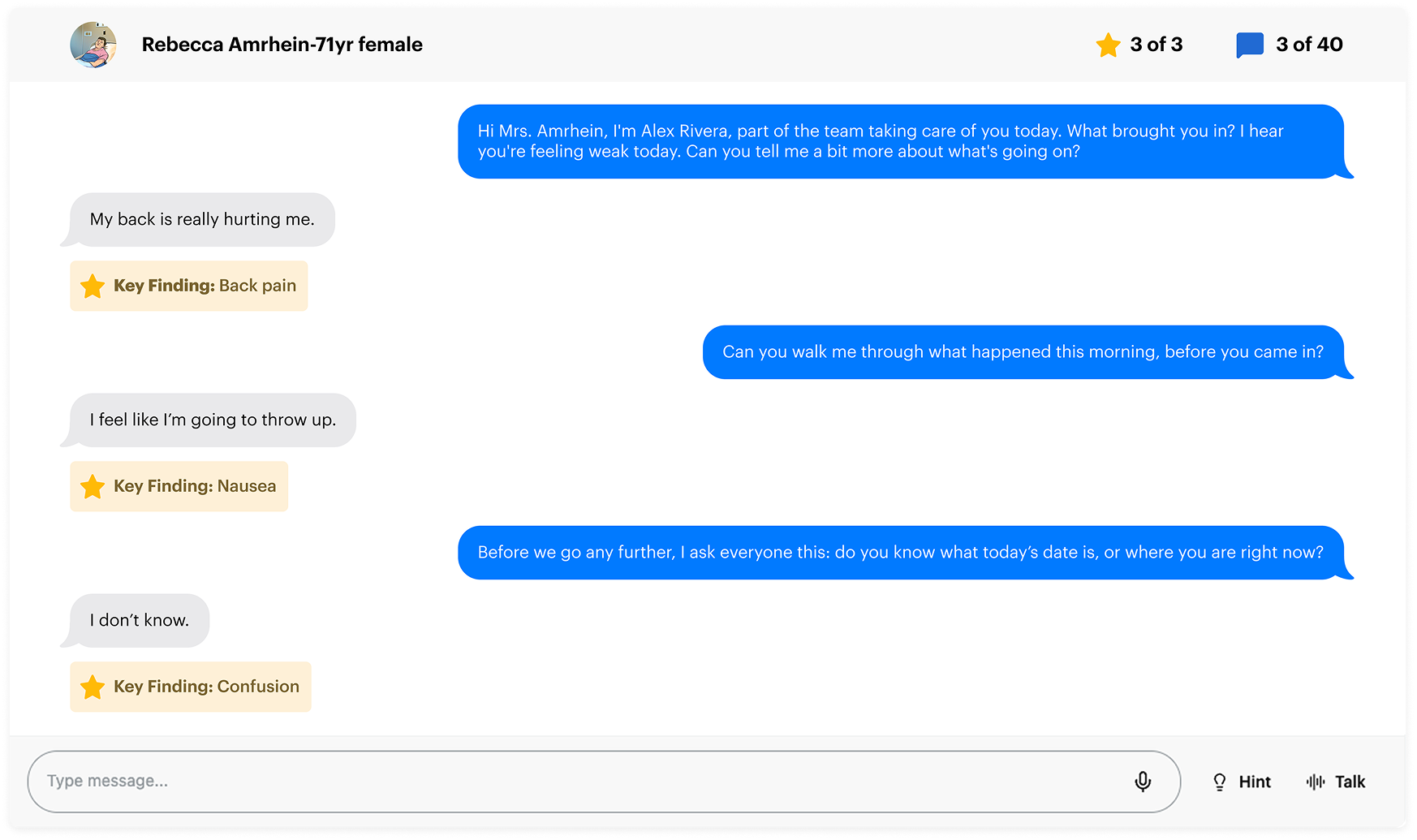
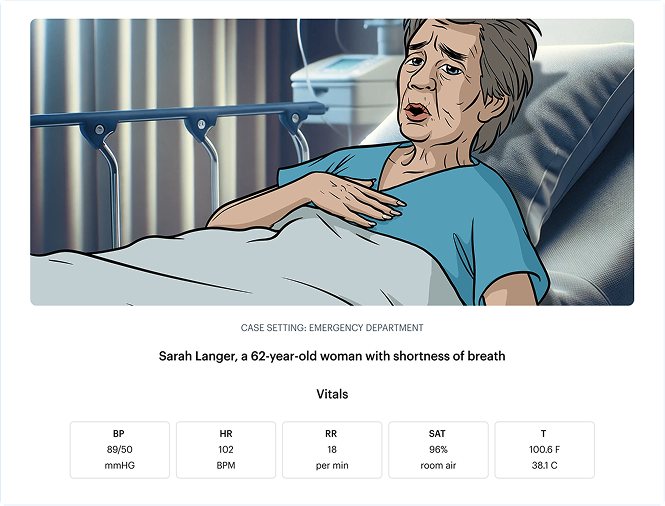
Every case opens with a chief concern and vitals. Then, type or talk with a virtual patient to take the history, perform your physical exam, and start uncovering key findings.
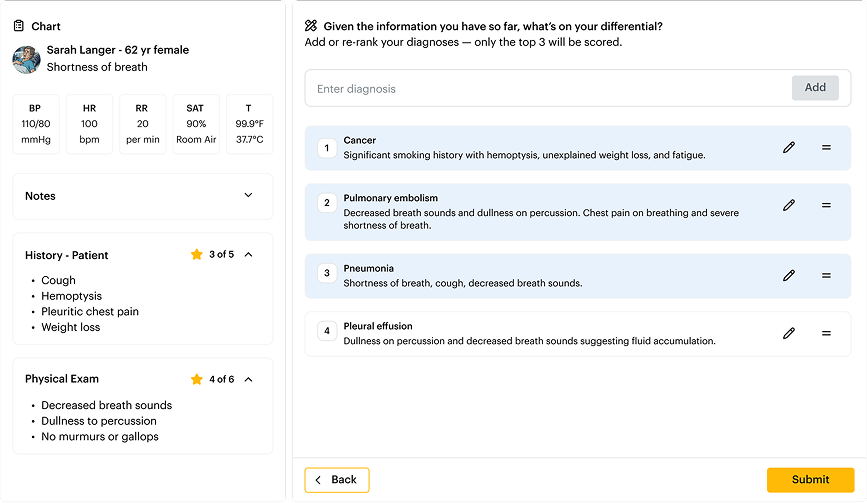
02 Differential

Build and rank your DDx.

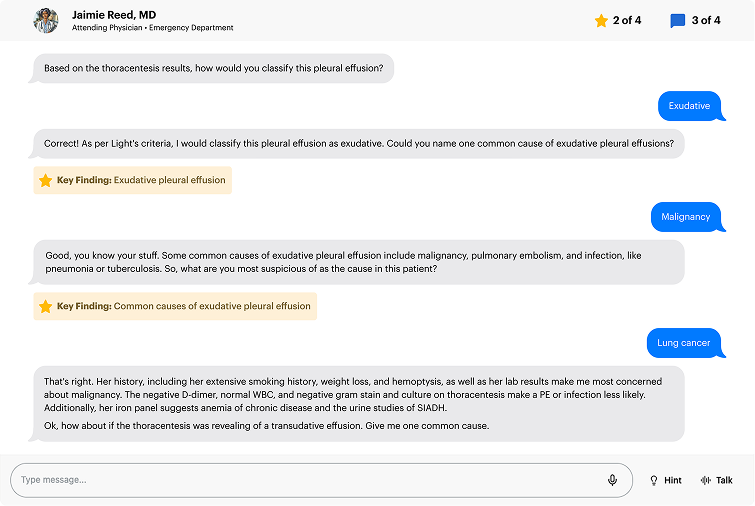
Add diagnoses, rank them, and reorder your differential as new findings come in. Defend your reasoning to your attending.
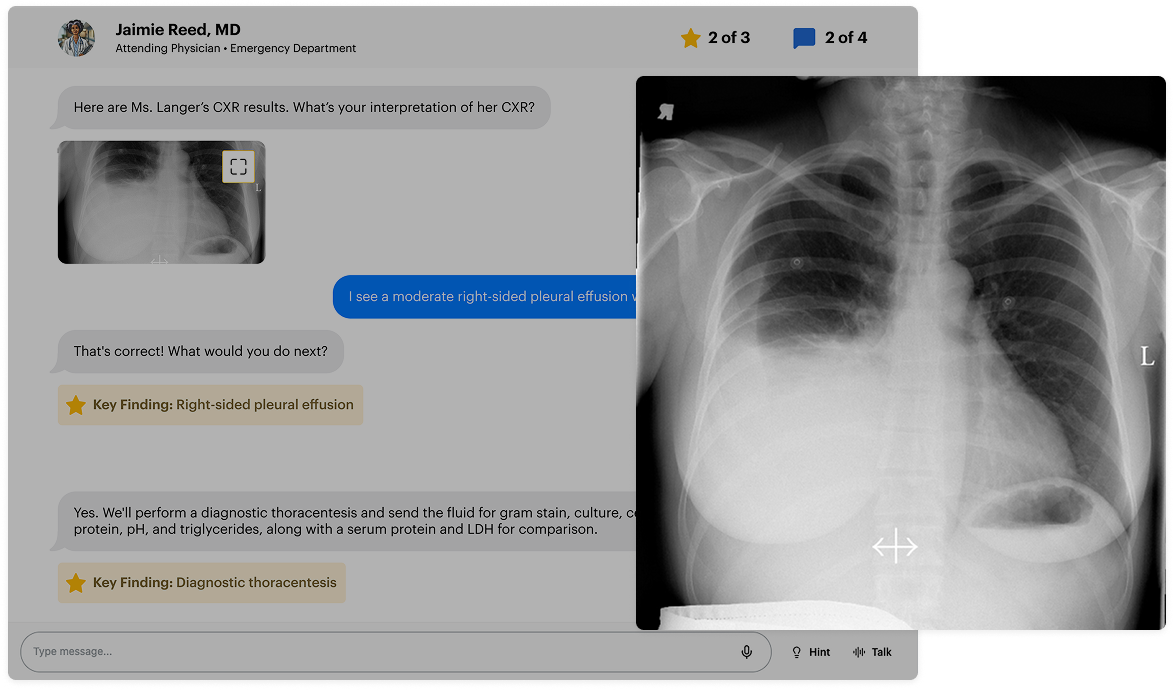
03 Orders & Results

Make sense of the workup.

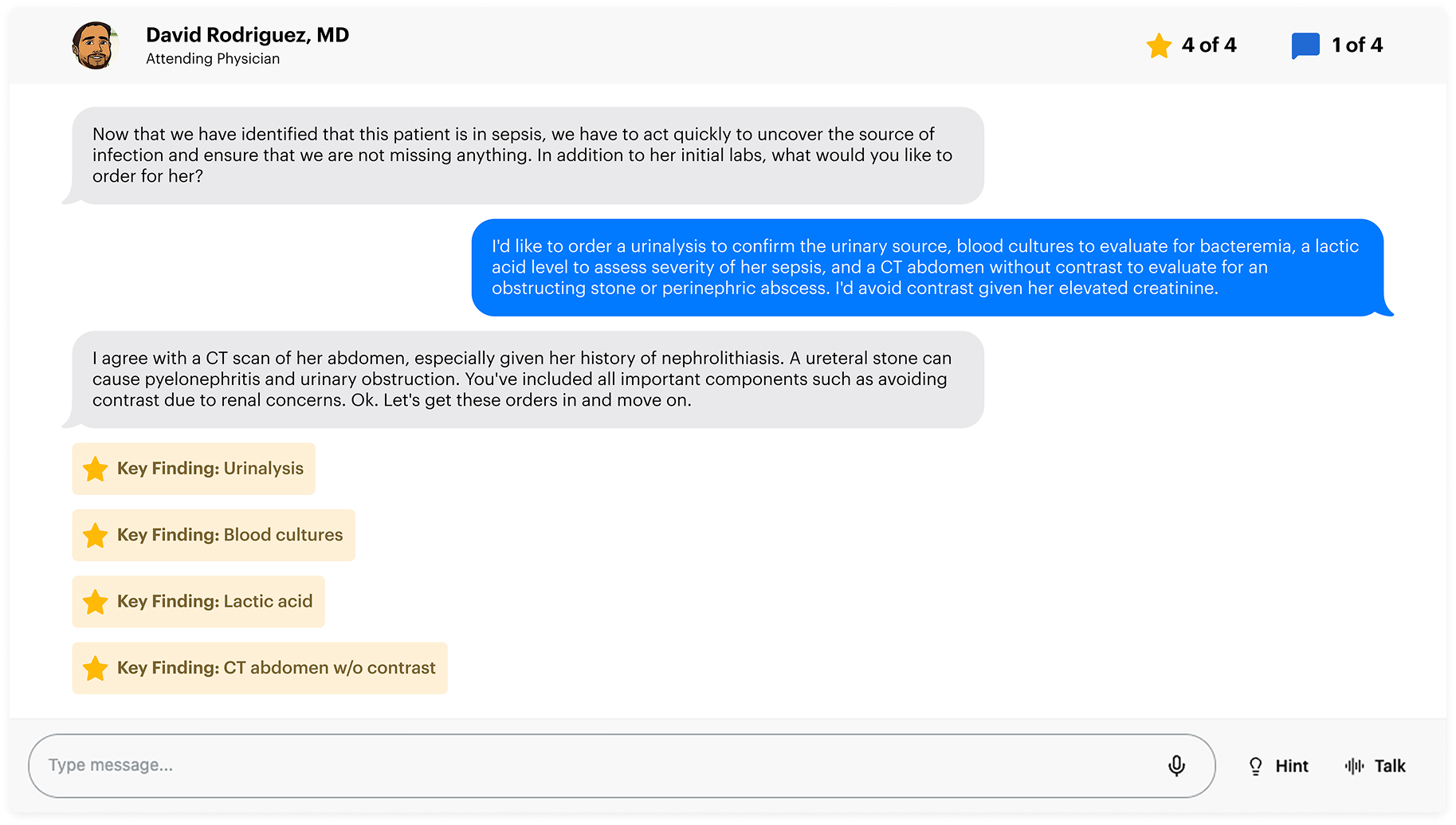
Order labs, ECGs, X-rays, and more. Spot what's abnormal and interpret it yourself, the way you will in the clinic.
04 Management

Decide the next best step.

Propose your management plan and explain your reasoning. Your attending affirms it or guides you to the right call, no cold sweats required.
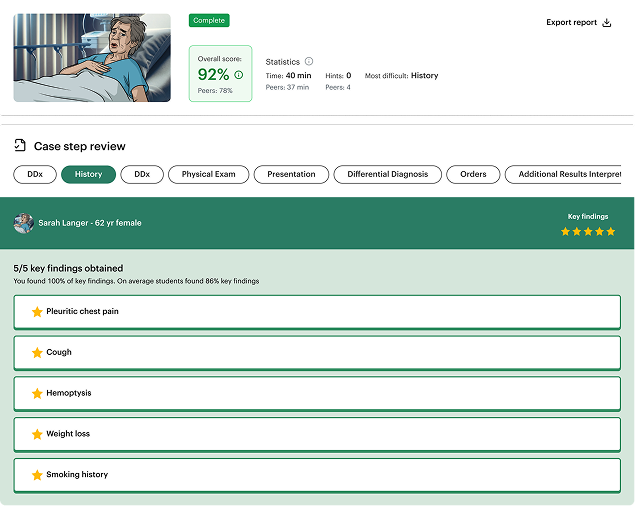
05 Feedback

See how you measured up.

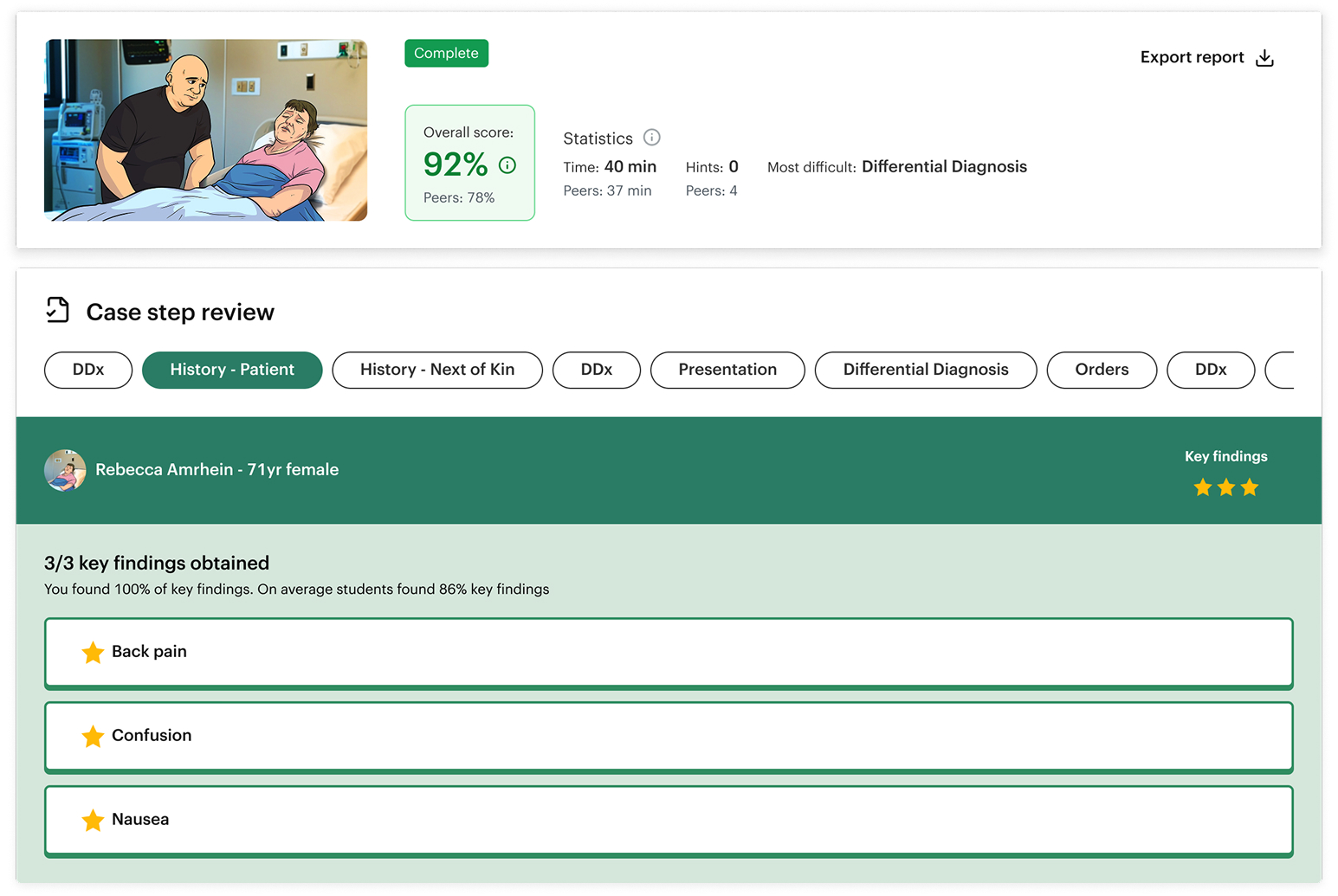
Get a step-by-step review of your clinical reasoning and how you compared to peers, with links to relevant Sketchy lessons to make sure you never forget again.

Master the exam. Maximize your score.

Built for shelf, USMLE, and 
COMLEX prep

The same clinical reasoning these exams test, built to stick with you. Without multiple choice to lean on, you build the kind of recall that holds up on exam day and on the wards.

Board-style case structure

Work through the same pieces every board question is built from: chief complaint, key findings, diagnosis, management. By exam day, the vignettes feel like cases you've already seen.

Feedback now, payoff on test day

Your virtual attending corrects your reasoning in real time, with high-yield teaching points and MCQs built in. Fix your thinking before the exam tests it.

Case coverage that matches the exams

Our case library covers the high-yield presentations your shelf exams, Step 2 / Level 2 exams test, spanning every core rotation. Build the clinical reasoning that shows up on exams.

Built for EOR, PACKRAT, and PANCE prep

The same clinical reasoning these exams test, minus the multiple choice to hide behind. Just you, a patient, and your differential. Build the recall that holds up on EORs and the PANCE.

Board-style case structure

Work through the same pieces every board question is built from: chief complaint, key findings, diagnosis, management. By exam day, the vignettes feel like cases you've already seen.

Feedback now, payoff on test day

Your virtual attending corrects your reasoning in real time, with high-yield teaching points and MCQs built in. Fix your thinking before the exam tests it.

Case coverage that matches the exams

Our case library covers the same high-yield presentations your EORs and PANCE pull from, across every core rotation. The reasoning you build here is the reasoning they test.
felt more prepared for clinical rotations
recommend Sketchy Cases to other students
felt more confident seeing real patients

Walk in ready. Answer on the spot.

Make mistakes here. Not on the wards

Ask the "stupid" question. Order the wrong test. Look something up. Clinical training with zero repercussions: no grade, no attending watching, no patient on the line.

Walk into 
rounds ready to get “pimped”

"What's your differential? What else? What's your next step?" Drill the on-the-spot questioning you'll face on rounds, so when your attending fires, you're ready.

Built like a virtual OSCE

Take the history, ask focused questions, work up the patient: the same skills your OSCE scores. Practice like you play.

See the cases your rotation might not

Practice in cases what you don’t see in person. High-yield bread-and-butter cases (and a whole herd of zebras) level the playing field no matter where you train.

Make mistakes here. Not on the wards

Ask the "stupid" question. Order the wrong test. Look something up. Clinical training with zero repercussions: no grade, no attending watching, no patient on the line.

Walk into 
rounds ready to get “pimped”

"What's your differential? What else? What's your next step?" Drill the on-the-spot questioning you'll face on rounds, so when your attending fires, you're ready.

Built like a virtual OSCE

Take the history, ask focused questions, work up the patient: the same skills your OSCE scores. Practice like the real thing, minus the nerves.

See the cases your rotation might not

Practice in cases what you don’t see in person. High-yield bread-and-butter cases (and a whole herd of zebras) level the playing field no matter where you train.
felt more prepared for clinical rotations
recommend Sketchy Cases to other students

Every rotation. Every system. One library.

405+ cases across every core rotation and setting. Plus full case coverage for every Micro, Pharm, and Path lesson, so that what you study links straight to a patient.

Rotations covered:

Internal Medicine

150+ cases

Neurology

15+ cases

OB/GYN

20+ cases

Emergency Medicine

75+ cases

Surgery

5+ cases

Family Medicine

55+ cases

Psychiatry

5+ cases

Pediatrics

35+ cases

Body systems covered:

Reproductive

Cardiovascular

Renal / GU

Rheum / MSK / Integumentary

GI / Hepatobiliary

Endocrinology

Hematology & Oncology

Pulmonology

Nervous System / Psych

Infectious Disease

Credentialed physicians created Sketchy's cases.

Our curriculum, content, and cases are written and reviewed by physicians and educators from top medical schools including UCLA, Columbia University, and UC Irvine.

Loved by students like you.

Being able to form a DDx, order labs, interpret labs, talk in real time to a patient to see if you fumble your words — it makes a world of difference.
— Leo Fric, PA Student · Didactic Year
It's a great way to replicate OSCE situations and patient encounters.
— Callie Linnens, PA Student
It simplifies differential diagnosis. By grouping similar pathologies into distinct scenes, Sketchy helps you quickly distinguish between 'look-alike' diseases on high-stakes exams.
— Nikki Rothe, PA Student · Clinical Year

The study break that still counts.

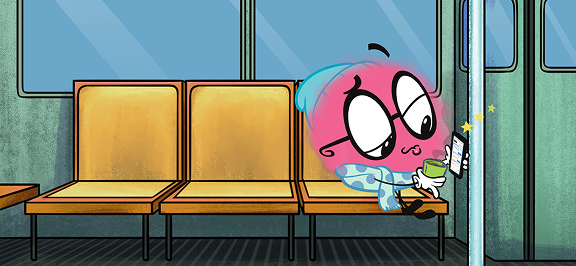
Burnout is real, and sometimes you need a break from grinding through questions. Game-style cases are it: quick, low-stress, and still building the recall and reasoning you need. Your brain thinks it's resting. It isn't.
Mini Cases

Bugs & Drugs

Stat Read

DxDash
GuesSTI
Path-o-Finder
Bootcamp

Mini Cases

Bugs & Drugs

Stat Read

DxDash

GuesSTI

Path-o-Finder

Bootcamp

Get started for free, no strings attached

All access

Complete learning for didactic coursework, board prep, & clinical reasoning

Lessons & QBank
Preclinical & clinical courses
End-of-lesson quizzes
Unlimited custom tests
Interactive patient cases
Full patient encounters
Core rotations & systems
Practice clinical skills
new

Cases only

Clinical reasoning skill-building for board prep & the wards

Interactive patient cases
Full patient encounters
Core rotations & systems
Practice clinical skills

Start your for free trial now. Cancel anytime.

Frequently Asked Questions

Do Sketchy cases align with EOR exams and PANCE?

Sketchy cases mimic what shelf exams are actually testing: clinical reasoning through a patient, not picking A through E. Each case is a board-style patient vignette mapped to the content you'll face on shelf exams and Step / Level 1 & 2, covering Internal Medicine, Neurology, Family Medicine, Pediatrics, and more.

How do Sketchy cases align with the Sketchy lessons I already use?

Every Micro, Pharm, and Path lesson on Sketchy has corresponding cases that apply what you learned. So when you finish a lesson, there's a case waiting to test your reasoning on a real patient with that condition.

Do Sketchy cases help with OSCE prep?

Yes. Sketchy cases are built to help you prep for OSCEs by reinforcing the skills you'll be tested on: clinical decision-making, communication, and thinking on your feet.  With speech-to-text, you can talk to the virtual patient and present your SOAP out loud, just like an OSCE station. You'll manage common scenarios across core specialties and build the confidence to reason clinically and sound like you know what you're doing. Because you will.

How do Sketchy cases fit into my existing study routine?

Sketchy cases fit into any study plan you’re already using. Here's how students use them at each stage:

  1. Pre-Clinical / Step 1 Prep: Pair one case with each unit or system you're reviewing to apply what you've learned. Stuck on your weakest subject after a practice exam? Search the case library by system and reinforce those gaps with real scenarios.
  2. Clinical Year (MS3): Saw a tough case in clinic that left you stumped? Review it that night by searching the chief complaint in the case library. Or use cases before shelf exams to cover high-yield presentations you didn’t see in person.
  3. Step 2 CK Prep: Use Sketchy Cases to target the skills you're still shaky on from NBME or QBank practice exams. Filter by skill or system and drill it through realistic clinical vignettes.
  4. MS4 + Intern Prep: Getting ready for residency? Sketchy's more advanced cases help you refresh core knowledge and think through complex presentations before you're the one writing the orders.