


The Residency Match: A Medical Student's Perspective


The residency match is one of the most significant transitions in a medical career. Understanding each stage from ERAS to Match Day helps demystify the process and makes it possible to approach it with both preparation and perspective.
The journey through medical school is a rigorous and transformative experience, culminating in one of the most anticipated and nerve-wracking events: the Residency Match in March each year. This year Match Day is March 21, 2025.
For medical students, the Match is the gateway to their future careers; it determines where they will train and what speciality they will practice within the world of medicine. This process, while exciting, can also be daunting due to its complexity and the high stakes involved.
As a student navigating this path, understanding each step of the Match process is crucial. For loved ones supporting someone in medical school—especially those currently awaiting Match Day—understanding the process can help you better relate to their experience and provide reassurance and helpful distractions as needed. This blog post aims to provide insight into the Match from a student’s perspective, and it offers guidance and personal reflections on this pivotal experience.
The Match is not just a logistical hurdle; it’s a rite of passage that signifies the transition from medical student to resident physician. The emotions tied to this process range from hope and excitement to anxiety and uncertainty. This post will delve into the various stages of the Match by providing a comprehensive overview that will help demystify the experience.
By sharing insights and tips, I hope to offer support and encouragement to those embarking on this journey. And—fun fact—this blog post was written on March 12th, just nine days from Match Day!
As you read through, whether you’re a student or loved one of a student, remember that while the Match is an important step in one’s medical career, it’s just one part of a broader journey as a physician. Each stage of the process offers opportunities for growth, reflection, and self-discovery.
What is "The Match"?
The Match, formally known as the National Resident Matching Program (NRMP), is a sophisticated system designed to pair medical students with residency programs across the United States. Established in 1952, the NRMP was created to address the chaotic and competitive nature of residency placements at the time. Today, it stands as a model of fairness and transparency, utilizing a computerized algorithm to match applicants with programs based on mutual preferences. As of 2025, there are a few specialties who do not use the NRMP, namely the military match, ophthalmology, and urology.
The algorithm used in the Match is a marvel of mathematical precision. It operates on the principle of optimizing choices for both applicants and programs, ensuring that each participant receives the best possible outcome based on their rank lists. This system, known as the Gale-Shapley algorithm, was even awarded the Nobel Prize in Economic Sciences in 2012 for its application in matching markets. Understanding how this algorithm works can help demystify the process and reassure students that their preferences are given priority. Feel free to click here and go straight to the source - a video from the NRMP that describes the algorithm better than I ever could. This is the video I have sent in my family group chat and, admittedly, have watched a few times myself.
Participating in the Match is a significant milestone in a medical student's career. It involves careful planning, introspection, and decision-making. For many, the Match represents the culmination of years of hard work and dedication, marking the beginning of their professional journey in medicine.
As you prepare to enter this process, it’s important to approach it with both optimism and pragmatism, knowing that it’s designed to align your aspirations with the needs of residency programs.
The Basics of Applying to Residency
The residency application process begins long before students submit their materials, through the Electronic Residency Application Service (ERAS). (Of note, there are now a few competitors to ERAS, including the ResidencyCAS.) Preparation involves building a strong academic and extracurricular profile throughout medical school. This includes excelling in coursework, gaining clinical experience, participating in research, and engaging in leadership and community service activities. These experiences not only enhance a student's application but also help clarify their interests and career goals.
When it comes time to apply, students must assemble a comprehensive application package. This includes letters of recommendation from faculty and mentors who can speak to their clinical skills, work ethic, and character.
A personal statement is also required, offering applicants the opportunity to articulate their passion for medicine and their chosen specialty. Crafting a compelling personal statement involves reflection and self-assessment, as it should convey both personal and professional aspirations.
Then, applicants identify up to ten “activities” and write a short statement about them. This is the meat & potatoes of the application as these ten activities help demonstrate, along with your grades and personal statement, what you have been up to the last four (or more) years.
Choosing which specialties and programs to apply to is another critical aspect of the application process. Students often seek guidance from advisors, mentors, and peers to make informed decisions. Factors such as program reputation, location, and training opportunities play a significant role in this decision-making process. It’s essential for students to balance ambition with realism, and apply to a range of programs that align with their qualifications and interests. It’s not uncommon for a student to apply to more than one speciality. There are countless reasons why someone might apply to more than one specialty, and this adds another layer of anxiety — as they won’t know which specialty they will ultimately match into until Match Week.
Interview Season
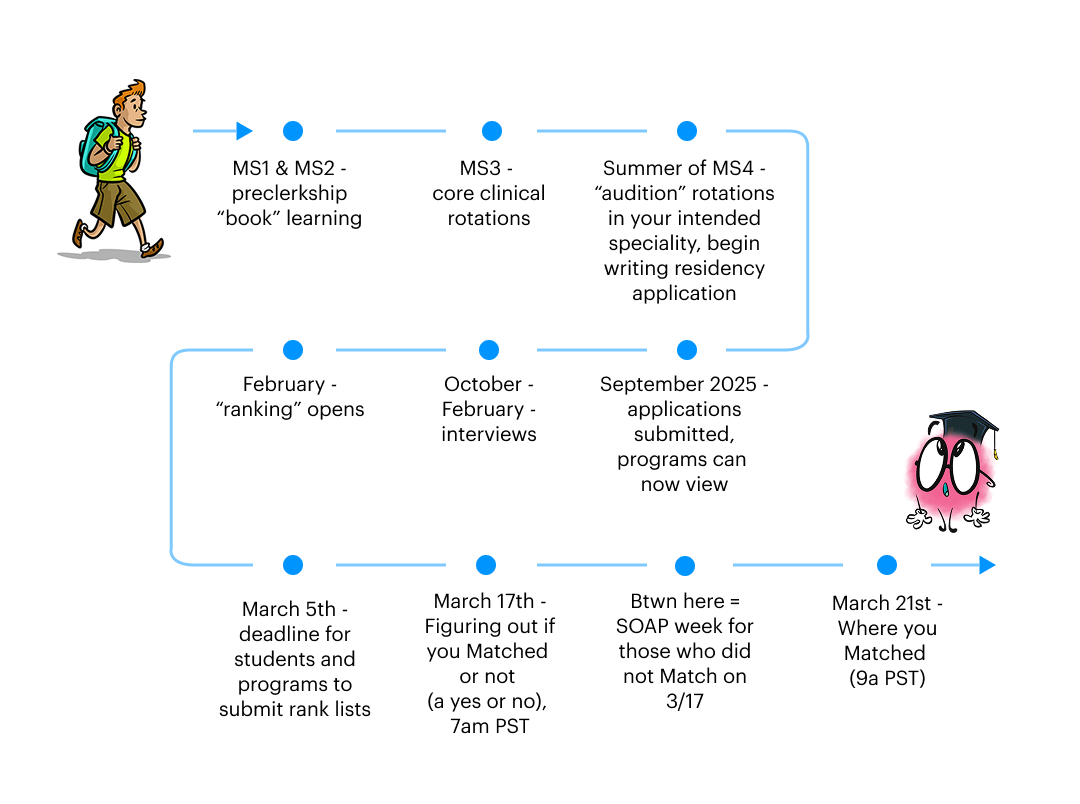
Interview season is a pivotal phase in the residency application process, occurring between October and February. During this time, applicants virtually interview with various programs and interact with faculty, residents, and program directors.
Prior to COVID-19, residency interviews were overwhelmingly in-person affairs. Following the shift to virtual interviews during the pandemic, many specialties have continued this format as it lowers the financial burden on already significantly-in-debt applicants. Interviews provide a unique opportunity for students to showcase their personalities, skills, and fit for a program. However, a downside to virtual interviewing is that the limited opportunity to gain firsthand insights into the program’s culture, values, and training environment.
Interview season is often described as a whirlwind of emotions. It’s a time of excitement and anticipation as students envision their future roles as residents. Unlike medical school interviews where the common sentiment is “I just need one school to take me,” residency interviews place more emphasis on the applicant interviewing for the program.
However, it can also be exhausting, with the demands of balancing interviews and ongoing academic responsibilities. Maintaining a balance between preparation and self-care is crucial during this period. Students are encouraged to reflect on each interview experience, taking notes on their impressions and interactions to aid in the subsequent ranking process.
Making Your Rank List
After completing interviews, students face the task of creating a rank order list of the programs they wish to attend. This list is a reflection of their preferences, based on the insights gained during interviews and their personal and professional priorities. Crafting a rank list is a deeply personal process that requires careful consideration and introspection.
When making a rank list, students must weigh various factors, including program culture, geographic location, work-life balance, and the specific training opportunities offered. It’s essential to rank programs in one’s personal order of preference, as the Match algorithm is designed to favor the applicant’s choices. This means that students should prioritize their own interests and goals rather than trying to predict how programs might rank them. As someone who recently submitted my rank list, this was a hard concept to grasp.
Creating a rank list often involves discussions with mentors, advisors, and family members. These conversations can provide valuable perspectives and support, helping students to clarify their preferences and make informed decisions.
Ultimately, the rank list should reflect the student's true aspirations and align with their vision for their medical career. It’s a critical step that sets the stage for the next phase of their journey.
The Wait Between Rank List Submission and Match Day
The period between submitting your rank list and Match Day (a period of about two weeks) can be filled with anticipation and anxiety. Students often find themselves reflecting on their interviews and potentially second-guessing their decisions. It’s a time to practice patience and focus on other aspects of life while awaiting the results. Some will choose to find potential housing in their top three locations, while others will fill their time with anything that will take their mind off the coming decisions. Personal strategies for coping with this wait can vary.
For myself, this period has been filled with mixed emotions. On one hand, there is bliss in knowing there is truly nothing more that could be done as both myself and the programs I am interested in have submitted their lists. But, the thought of “what happens if I don’t Match” comes creeping in occasionally. There is a mix of “wow this program would truly allow me to grow as a person and a physician” but “it’s 3000 miles away from family.” I am truly grateful to know that if I Match, I would be happy at any program that’s on my list. On a less serious note, I’ve been enjoying my anesthesia rotation and playing lots of video games, and I just enjoyed a week in Mammoth Mountain!
What is Match Week? What is Match Day?
Match Week marks the culmination of the residency application process, and it begins on the Monday before Match Day (which is always the third Friday of March). On Monday, students receive an email notifying them whether they have matched to a program, although the specific program remains unknown until Friday. This initial notification can bring a sense of relief or disappointment, depending on the outcome. For those who do not match, the Supplemental Offer and Acceptance Program (SOAP) provides an opportunity to secure an unfilled position.
Throughout Match Week, emotions run high as students await the final reveal on Match Day. Programs find out who they matched on Thursday and, behind the scenes, begin preparing contracts (participating in the Match is a binding agreement with serious consequences for not continuing on to the program you matched at) and social media posts.
Medical schools also find out the day before as they prepare envelopes for students to open at Match Day ceremonies. This day is often celebrated with peers, faculty, and loved ones, as students gather to open their Match letters and discover their future training destinations. The atmosphere is one of excitement and camaraderie, as classmates share in each other's successes and support one another through any challenges. However, it can be a day of mixed emotions—while you may feel incredibly happy to have matched, you might not be entirely thrilled with where you ended up.
Match Day itself is a milestone that signifies the transition from medical student to resident physician. It’s a moment of joy and accomplishment, as students see their hard work and dedication come to fruition. For some, it may also be a time of reflection and adjustment, as they prepare to embark on a new chapter in their medical careers. Regardless of the outcome, Match Day is a memorable event that marks the beginning of the next stage in a physician's journey.
Conclusion
The Residency Match is a defining moment in the life of a medical student, marking the transition from student to physician-in-training. Understanding each step of the process can help demystify the experience and provide reassurance during this challenging time.
Whether you are just beginning to explore residency options, are in the midst of interviews, or are a supportive loved one, remember that the process is incredibly unique. The Match is not just about securing a position but about finding a place where you can grow, learn, and thrive as a future physician.
On a personal note, I am incredibly thrilled to begin my training as an emergency medicine physician. I would not be here without my family, my wife, and my mentors. It truly does take a village.
